I still have a jacket I bought before my first child was born. It doesn't fit the same way anymore not because my body changed dramatically, but because I never go anywhere that jacket belongs. It hangs there as a kind of artifact. Evidence of a person who used to exist.
I think a lot of mothers have a version of that jacket.
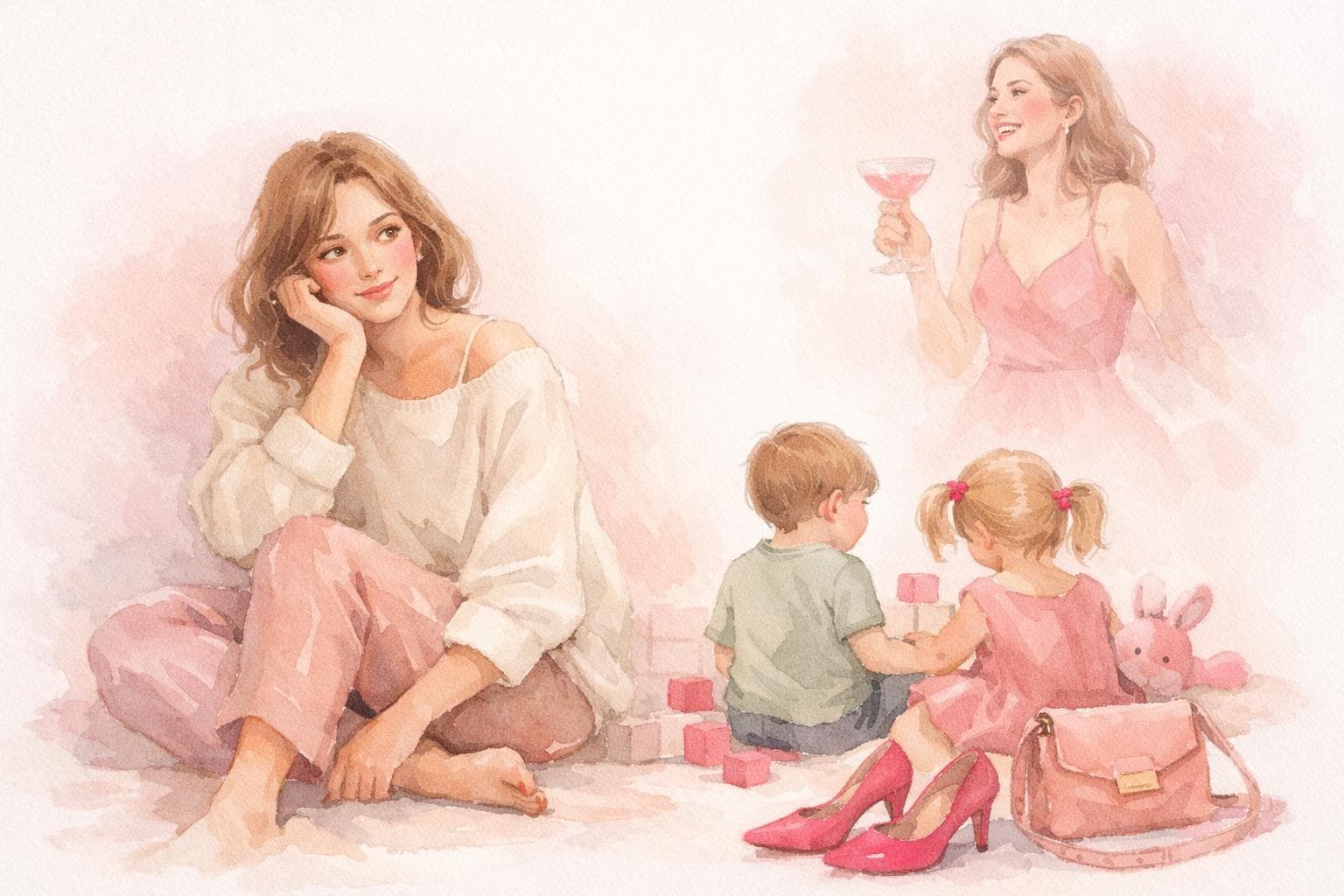
It could be an old journal full of ambitions that now feel foreign. A job title that used to define you. A social life that required a babysitter to access. A version of yourself that moved through the world differently lighter, maybe, or just less responsible for everything all the time.
Letting go of who you were before kids isn't a single moment. It's a slow, uncomfortable process that rarely gets acknowledged for what it is: grief. Not the grief of losing someone you loved. The quieter, stranger grief of losing a version of yourself you didn't know you'd miss until she was already gone.
Nobody calls it grief but that's what it is
We talk a lot about what mothers gain. The love, the purpose, the perspective. And those things are real. But the cultural conversation around what mothers lose is almost nonexistent as if naming the loss would mean you regret the children which is not the same thing at all.
Psychologist Nancy Chodorow in her influential work on maternal identity, argued that the transition to motherhood involves a fundamental restructuring of the self not an addition to an existing identity but a displacement of it. The old self doesn't simply make room. It gets reorganized around something new and some of what it held doesn't survive that reorganization.
That's not a failure. It's just what happens.
A 2021 study published in Psychological Science found that new mothers showed measurable changes in personality across the first year postpartum particularly in openness to experience and neuroticism that persisted beyond the initial adjustment period. The researchers noted that these changes were not simply adaptations to stress, but genuine shifts in who these women were at a dispositional level.
Your identity changed. The old version of you isn't coming back exactly. And somewhere between accepting that and grieving it is where most mothers live for a while.
What you're actually letting go of
It helps to be specific. Because "letting go of who you were" is abstract enough to feel either too large to attempt or too vague to take seriously. In practice, it tends to look like releasing:
- The version of yourself who had unstructured time and didn't fully appreciate it
- A professional identity built over years that is now on pause or permanently altered
- A body that felt familiar in ways it no longer does
- Friendships that assumed an availability you can no longer offer
- The particular freedom of being responsible only for yourself
- Plans five-year plans, ten-year plans that quietly became irrelevant
- A self-concept that didn't include the word "mother" and everything that comes with it
None of these are small. And none of them need to be let go of quickly or completely. Grief isn't an assignment with a deadline.
The difference between letting go and losing
This is the distinction that matters most and the one that's hardest to hold onto in the early years.
Letting go is an active process. It involves acknowledging what's changed, mourning what's gone and making a conscious decision about what to carry forward and what to leave behind. It leaves you lighter, eventually not because you've forgotten but because you've integrated.
Losing is passive. It's what happens when the self erodes without acknowledgment when you simply stop doing the things that made you yourself, stop being known as a full person, stop asking what you want, until one day you look up and can't quite remember.
Letting go losing yourself
Conscious, gradual process
Happens without noticing
Involves grief and acknowledgment
Involves numbness and vague dissatisfaction
Leads to integration
Leads to depletion
You still know who you are
You're not sure anymore
Some things are released by choice
Everything goes
The goal isn't to hold on to the pre-kids self at all costs. That's not possible, and trying tends to create its own suffering. The goal is to let go deliberately to choose what you're releasing rather than simply discovering one day that it's already gone.
If you've already crossed into the second column and are trying to find your way back, How to Feel Like Yourself Again After Kids is an honest starting point.
What stays even when everything feels different
Here's the thing that helped me most, when I finally found it: the self doesn't actually disappear. It goes underground.
The specific way you laugh at something absurd. The particular things that make you angry. Your instinct toward certain people and away from others. The thoughts that arrive uninvited at 2 a.m. that are entirely yours. These don't belong to motherhood. They belong to you. They were there before, and they're still there sometimes buried under exhaustion or obligation, but present.
Psychologist Dan McAdams, whose work on narrative identity has shaped how researchers think about selfhood across life transitions, argues that identity is not a fixed thing but a story we keep telling and revising. Motherhood in that framework is not the end of the story or a detour from it. It's a new chapter one that changes the arc of everything that came before, but doesn't erase it.
The woman you were before kids is still in the story. She's just not the whole story anymore.
"We do not grow absolutely, chronologically. We grow sometimes in one dimension, and not in another; unevenly." - Anaïs Nin
How to actually begin letting go
Not all at once. Not with a ceremony or a declaration. Usually with something much smaller.
You acknowledge the loss out loud to yourself, to a friend, in writing somewhere private. You stop pretending that the grief isn't there because you love your children. You allow both things to be true at the same time.
Then, slowly, you start asking a different question. Not who was I before? but what from that person am I bringing forward? Not everything needs to come. But something should.
Your creativity. Your ambition. Your particular sense of humor. The way you used to throw yourself into things that mattered to you. These aren't casualties of motherhood. They're the things worth protecting and worth building the next version of your life around.
Personal Growth After Becoming a Mother explores what that forward motion actually looks like the real version, not the inspirational poster version.
And if what you're carrying right now feels less like transformation and more like plain exhaustion, that's a valid place to be too. Emotional Exhaustion in Motherhood: What It Really Means is worth reading before you try to do anything else.
You don't have to finish grieving before you start growing. In most cases, they happen at the same time.
Further reading: Dan P. McAdams, The Stories We Live By (1993). Nancy Chodorow, The Reproduction of Mothering (1978). Pauline Boss, Ambiguous Loss: Learning to Live with Unresolved Grief (1999).