
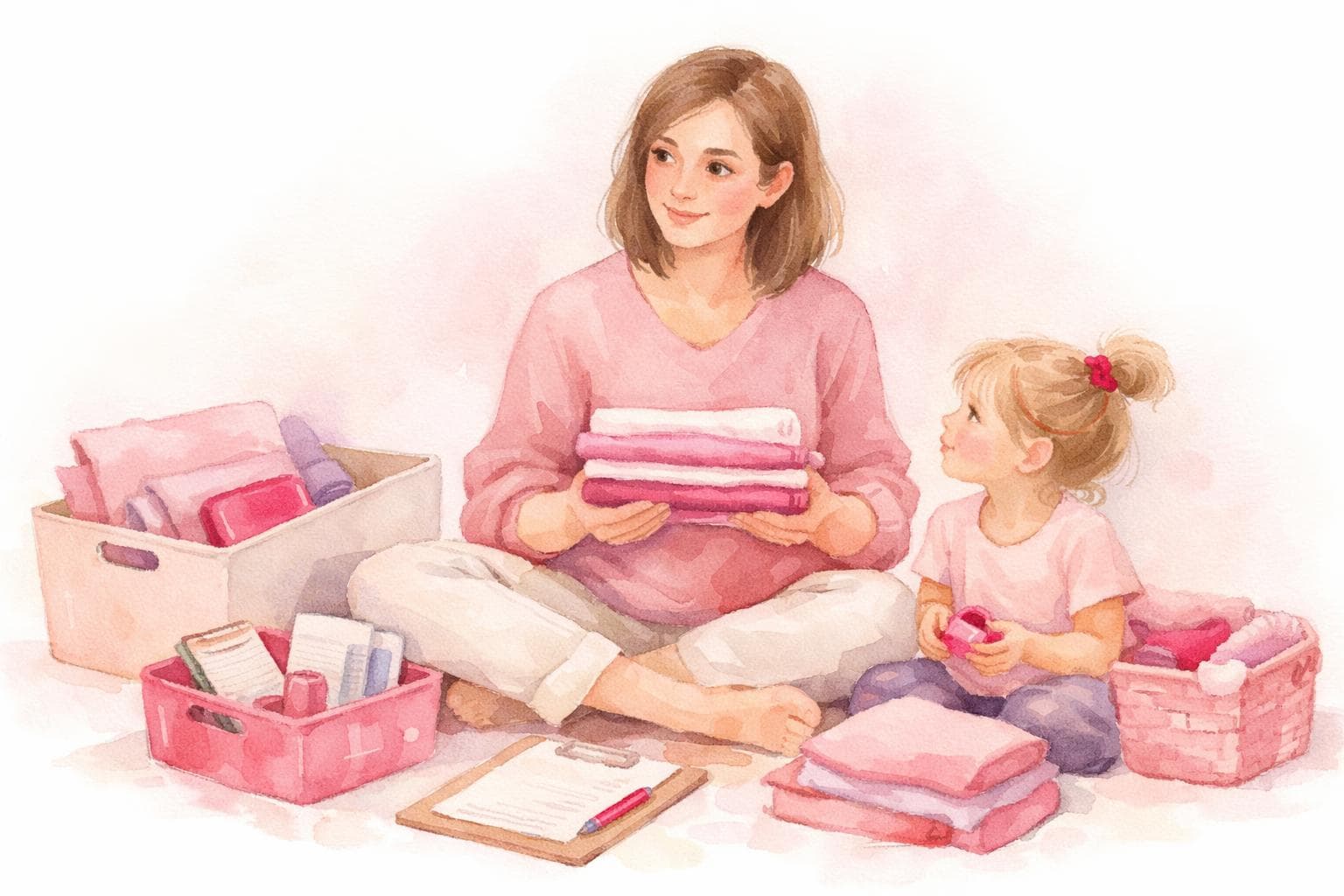
You look around your kitchen and it is not dirty exactly. It is just full. Bottles on the counter, a basket of unfolded laundry on the chair, toys spilling out of a box that was supposed to contain them. You think: I should sort this out. Then you think: I do not even know where to start. Then you sit down and open your phone instead because the overwhelm has already won.
If that cycle sounds familiar, you are not disorganised. You are overloaded. And the mess is not just an annoyance. It is actually working against your nervous system.
Why clutter affects moms more
A widely cited study from UCLA's Center on Everyday Lives of Families (CELF) found that women who described their homes as cluttered or full of unfinished projects had flatter cortisol slopes throughout the day. That cortisol pattern is associated with poorer health outcomes including chronic fatigue, depression and weakened immune function. Men in the same homes did not show the same effect.
Therapist Elizabeth Earnshaw wrote about this in Psychology Today in 2024, connecting the cortisol spike to mental load. When a woman sees clutter, she does not just see mess. She sees decisions: what needs sorting, what needs throwing away, what needs to be washed, returned, donated or put somewhere that does not exist yet. That processing loop is mentally exhausting, and it runs on top of everything else she is already carrying.
"When a woman sees clutter, she doesn't only notice the mess but begins to actively process what she is going to need to do next and how she will do it. This can create cognitive overload, which results in a stressed state." - Elizabeth Earnshaw, LMFT, Psychology Today (2024)
An experimental study published in PMC confirmed the causal link: when participants were placed in a cluttered, noisy environment designed to simulate household chaos, their stress responses increased and their caregiving quality declined.
The mess is not the problem. The problem is that your brain treats every piece of clutter as an open task. And for mothers managing the invisible mental load, those open tasks never stop multiplying.
Why most organisation advice fails moms
Most home organisation content assumes two things: that you have uninterrupted time and that the house starts in a neutral state. Neither is true when you have small children.
The laundry you fold gets unfolded. The toys you tidy get dumped out twenty minutes later. The surfaces you clear become covered again by evening. If you try to organise everything at once, you will burn out before you finish the kitchen.
That is why the goal is not a perfect house. The goal is a house that does not make you feel worse.
Where to actually start
Step one: pick one surface
Not a room. Not a floor. One surface. The kitchen counter, the hallway table, the bathroom shelf. Clear it completely. Wipe it down. Decide what lives there and what does not. Put everything else in a box to deal with later.
That single clear surface becomes your anchor point. When the rest of the house feels chaotic, you have one spot that is done. That matters more than it sounds.
Step two: apply the three-box method
For any space you tackle after the first surface, use three containers:
Box | What goes in it |
|---|---|
Keep here | Belongs in this room and has a place |
Relocate | Belongs somewhere else in the house |
Remove | Donate, recycle or bin |
Do not make decisions about sentimental items during this stage. Set them aside. Decision fatigue is real, and sentimentality under pressure leads to keeping things out of guilt rather than purpose.
Step three: create "homes" for the repeat offenders
Most household clutter is not random. It is the same ten categories cycling through: shoes, keys, mail, chargers, water bottles, hair ties, toys, school papers, nappies and bags. If those items do not have a designated place, they will always end up scattered.
Earnshaw describes this as "preventing": giving items a fixed home so that decisions about where things go become automatic rather than mentally taxing. It does not require an expensive storage system. A hook by the door, a tray on the counter and a basket in the living room can solve 80% of the visual noise.
The five-minute reset
This is the single most useful habit for overwhelmed mothers. Set a timer for five minutes once a day, ideally at the same time, and reset one room. Not deep clean. Not organise. Just return things to where they belong.
Five minutes is short enough that it does not feel like a project. Done consistently, it prevents the slow accumulation that turns a manageable space into an overwhelming one.
If mornings work better for you, you might fold this into the morning routine for exhausted moms as a final step before the day takes off.
What to let go of
Not every room needs to be tidy at the same time. Not every drawer needs a label. You do not need matching baskets. You do not need to sort your child's toys by developmental stage or colour-code your spice rack.
Here is what you can let go of right now:
- The guilt of not having a "Pinterest house"
- The belief that a tidy home means a good mother
- The expectation that you should enjoy organising
- The idea that your children will keep things tidy if you teach them early enough (they will learn, eventually, but not at two)
A 2016 Cornell University study found that stress triggered by clutter can lead to avoidance behaviours like overeating, oversleeping and binge-watching. In other words, the mess creates stress and the stress makes you avoid the mess. Breaking that loop does not require a full house overhaul. It requires one small win.
When the mess is a symptom
Sometimes a home that feels impossible to manage is not about the home. It is about what is underneath.
If you are struggling to do basic tasks, if the thought of opening a cupboard brings you to tears, if you feel paralysed rather than just tired, that may be a sign of something deeper. Emotional exhaustion and postpartum mood disorders can both show up as an inability to stay on top of things that used to feel manageable.
If that is where you are, the answer is not a better storage system. It is support. You can start by reading about how therapy can help moms who feel stuck or by talking to your GP about how you are feeling.
Your house does not need to be perfect. It just needs to stop being another thing that drains you.
Sources and further reading
- Saxbe, D. & Repetti, R. (2010). No place like home: home tours correlate with daily patterns of mood and cortisol. Personality and Social Psychology Bulletin. pubmed.ncbi.nlm.nih.gov
- Arnold, J. et al. (2012). Life at Home in the Twenty-First Century: 32 Families Open Their Doors. UCLA/Cotsen Institute of Archaeology Press.
- Earnshaw, E. (2024). Clutter, cortisol, and mental load. Psychology Today. psychologytoday.com
- Buisman, R. et al. (2022). The causal effect of household chaos on stress and caregiving: an experimental study. PMC. pmc.ncbi.nlm.nih.gov
- Vartanian, L.R. et al. (2017). Clutter, chaos and overconsumption: the role of mind-set in stressful and chaotic food environments. Environment and Behavior, Cornell University.
- Kondo, M. (2014). The Life-Changing Magic of Tidying Up. Ten Speed Press.