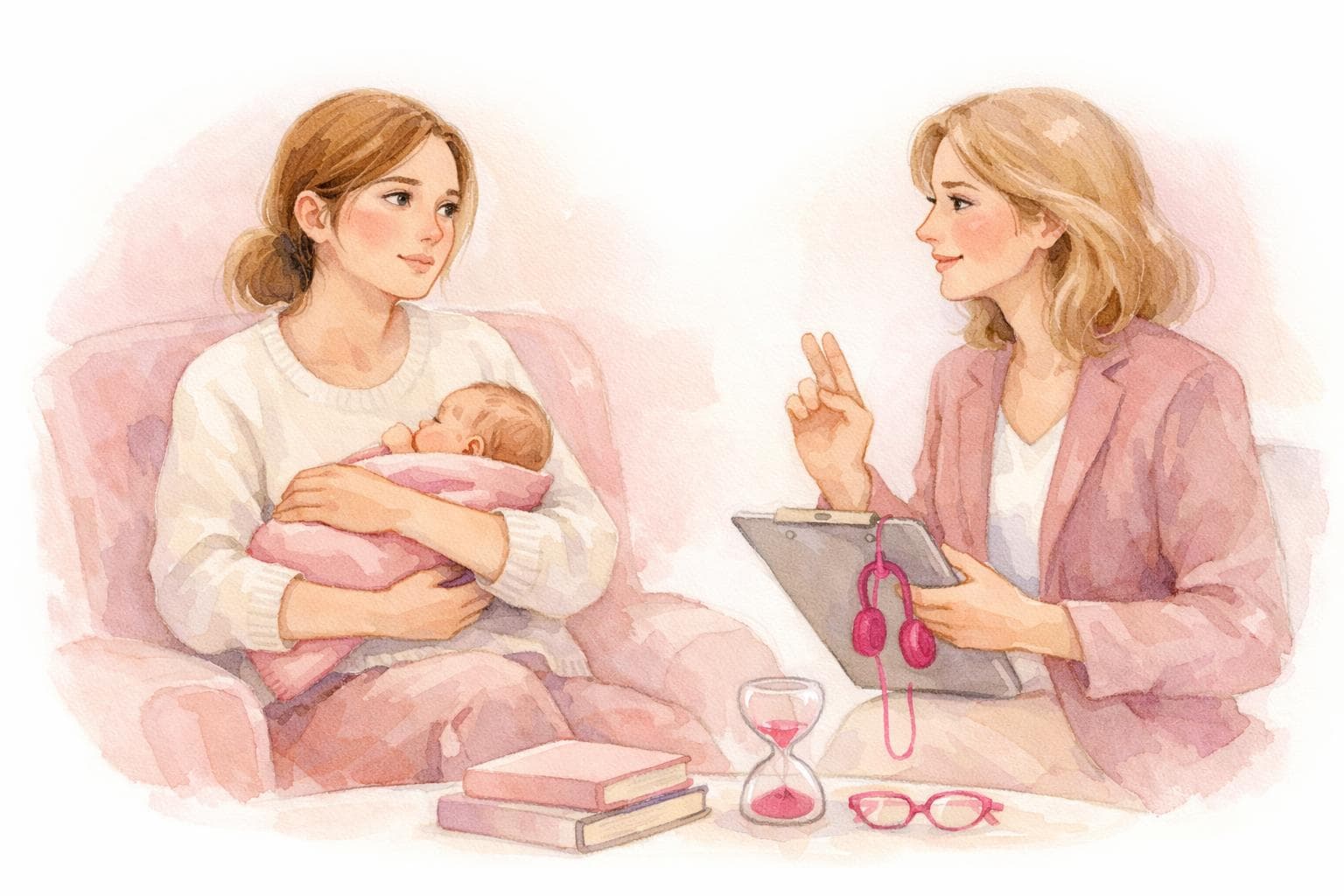
Finding a therapist is hard enough on its own.
Finding one who understands the specific texture of postpartum depression, who knows the difference between ordinary new-parent exhaustion and clinical depression, who is not going to spend the first three sessions asking about your childhood when what you need to talk about is what is happening right now, is considerably harder.
It is also considerably more important. A therapist who does not have perinatal mental health experience can miss things. They can misattribute symptoms. They can underestimate the severity of what you are experiencing or, conversely, overreact in ways that increase rather than reduce your anxiety about getting help.
This is a practical guide to finding the right person.
Why specialism matters for postpartum mental health
Postpartum depression presents differently from general depression. It often includes significant anxiety rather than simply low mood. It frequently involves intrusive thoughts, which in a general mental health context might be treated very differently than in a perinatal one. It occurs in the context of massive hormonal change, sleep deprivation and identity upheaval that a non-specialist may not fully account for.
Research published in Clinical Psychology Review found that treatment outcomes for postpartum depression were significantly better when delivered by practitioners with specific perinatal mental health training than by generalist therapists, even when the therapeutic approach was the same. The specialism was an independent variable.
The Edinburgh Postnatal Depression Scale, the most widely used screening tool for postpartum mood disorders, was designed to be administered by trained professionals because interpretation requires context. The same score means something different depending on what is driving it, and that requires knowledge of the perinatal period specifically.
What to look for in a therapist
Specific perinatal or postpartum experience. Look for this stated explicitly on their profile, website or directory listing. Phrases like "perinatal mental health," "postnatal depression" or "maternal mental health" are what you are looking for.
Familiarity with the conditions specific to the postpartum period. Postpartum depression, postpartum anxiety, postpartum OCD, postpartum PTSD and postpartum psychosis are distinct conditions that respond to different approaches. A good perinatal therapist knows the difference.
An approach that fits the presentation. CBT has the strongest evidence base for postpartum depression. EMDR and trauma-focused approaches are appropriate where birth trauma is a significant factor. Interpersonal therapy is well suited where relationship changes after becoming a parent are a major contributor. No single approach works for every person.
Availability in a format that works. Online therapy has significant evidence support and removes significant logistical barriers for mothers with young children. If leaving the house with a baby to attend a weekly appointment is going to prevent you from actually going, online or telephone therapy is a legitimate and clinically supported alternative.
Where to find perinatal mental health therapists
In the UK:
- NHS Talking Therapies (previously IAPT): self-referral is available in most areas of England. Ask specifically whether the service has perinatal mental health specialists. Some areas have dedicated perinatal IAPT pathways.
- Your GP can refer directly to a perinatal mental health team if one exists in your area. These are specialist NHS teams providing psychiatric and psychological support specifically for the perinatal period.
- PANDAS Foundation (pandasfoundation.org.uk) provides peer support and a directory of professionals.
- The British Association for Counselling and Psychotherapy (BACP) directory (bacp.co.uk) allows filtering by specialism.
In the US:
- Postpartum Support International (postpartum.net) maintains the most comprehensive directory of perinatal mental health providers in the US, searchable by state and approach.
- Psychology Today's directory (psychologytoday.com) allows filtering by issue type including postpartum depression and perinatal mental health.
- Your OB-GYN or midwife may have direct referral relationships with perinatal specialists.
Questions to ask before you book
You are entitled to ask questions. A good therapist will welcome them.
Question | What you are assessing |
|---|---|
What experience do you have with postpartum depression specifically? | Genuine specialism vs. general mental health background |
What approaches do you use for perinatal mood disorders? | Whether their methods match the evidence base |
Do you have experience with intrusive thoughts in the postpartum period? | A specific and common presentation that requires careful handling |
How do you approach birth trauma? | Whether they distinguish this from general depression |
Do you offer online sessions? | Logistical accessibility for mothers with young children |
What to do if you cannot access a specialist quickly
Waiting lists are a reality in many areas. If you need support while you wait:
- Self-refer to NHS Talking Therapies for faster access to general CBT, which still has good evidence for PPD even without perinatal specialism
- Contact PANDAS or PSI for peer support, which has its own clinical evidence base
- Use the online resources from Mind (mind.org.uk) or PSI while you wait for an appointment
- Return to your GP if symptoms worsen. A longer wait for the ideal therapist is not a reason to continue without any support
"Asking for help is not giving up. It is deciding that you deserve better." - Unknown
For more on what to actually say when you get to the appointment, how to ask for a mental health diagnosis as a mom covers the specific language that helps professionals take the presentation seriously. And for a broader understanding of treatment options beyond therapy, when therapy isn't enough: other mental health support for moms covers what else is available and when.
The right therapist exists. The search is worth doing properly.
Emergency support: Samaritans 116 123 (UK). 988 Suicide and Crisis Lifeline (US). PANDAS Foundation: pandasfoundation.org.uk. Postpartum Support International: postpartum.net.
Further reading: Karen Kleiman & Valerie Raskin, This isn't what I expected (2013). Wendy Davis, Transformed by postpartum depression (2015). NHS: perinatal mental health.