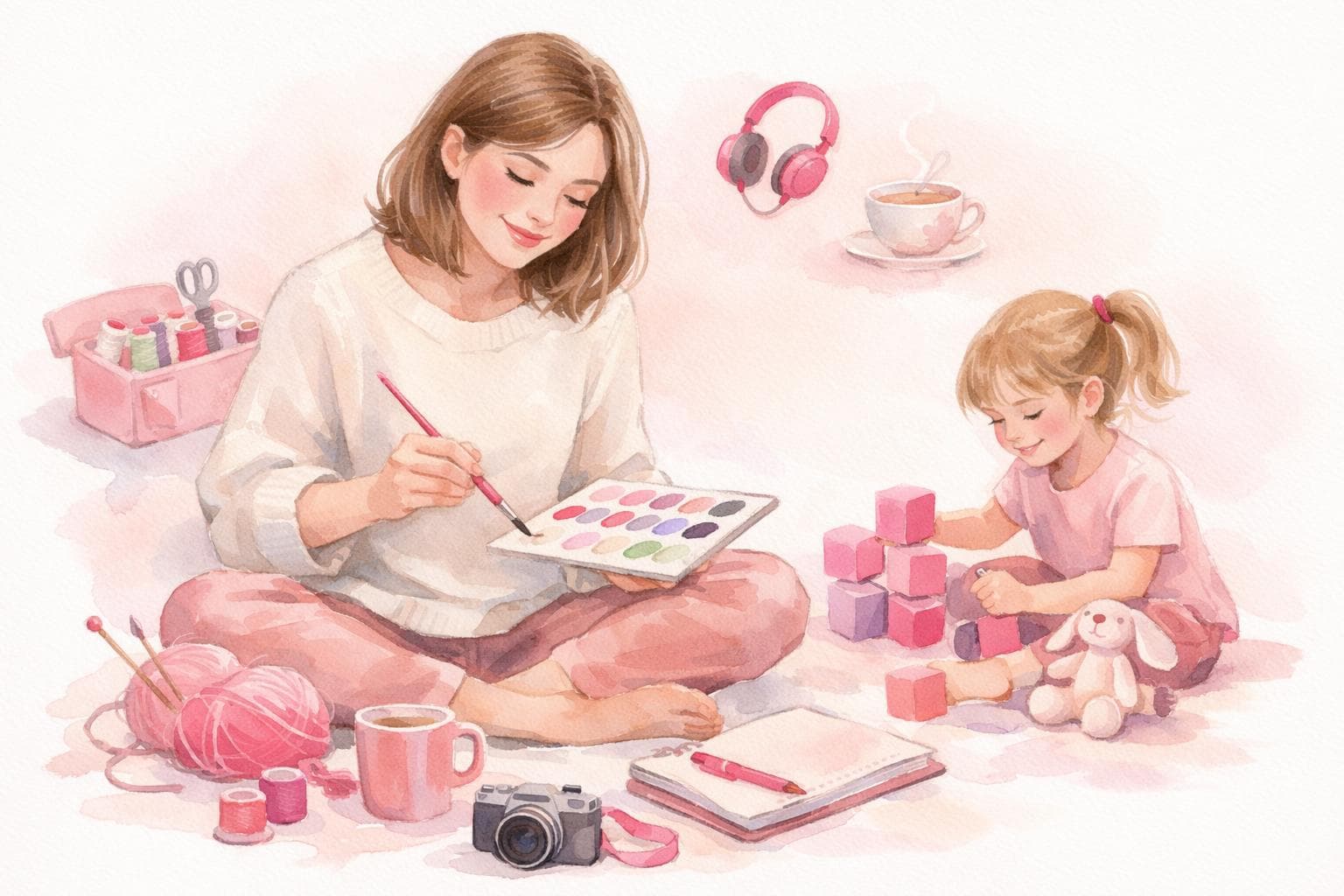
Someone asked me recently what I do for fun. Not what I do for my children or for the household or for work. What I do for fun.
I opened my mouth and genuinely could not answer.
I remembered things I used to do. I used to paint, badly and happily, on Sunday afternoons. I used to run, not for fitness particularly, but because it was the one hour of the week that belonged entirely to me. But somewhere in the accumulation of the last few years, all of that had quietly stopped, and I hadn't noticed until someone asked.
If that pause sounds familiar, this guide is for you.
Why finding a hobby as a mom actually matters
The word "hobby" sounds optional. Like something you do when you have spare time, which mothers famously do not have.
But the psychological function that a genuine leisure interest serves is not optional at all.
Psychologist Mihaly Csikszentmihalyi spent decades researching what he called "flow": the state of absorbed, effortless engagement that occurs when you are doing something that fully occupies your attention without overwhelming it. His research, published in Flow: the psychology of optimal experience (1990), found that people who regularly experienced flow reported significantly higher life satisfaction and a more stable sense of personal identity than those who didn't.
A 2021 study published in PLOS One confirmed this with more recent data, finding that leisure activities were associated with lower stress, better mood and reduced rates of depression and anxiety in adults. The mechanism is neurological: absorbing leisure activity reduces activity in the default mode network, the part of the brain responsible for rumination and self-critical thought.
In practical terms: a hobby gives the part of your brain that narrates your worries something else to do.
What gets in the way of finding a hobby as a mom
Before the solutions, the honest barriers. Because "just find something you enjoy" skips over all of them.
Not enough time. The real kind, not the aspirational kind. Most mothers with young children have pockets of time rather than blocks of it. A hobby that requires two uninterrupted hours is far less accessible than one that can be entered and exited in twenty minutes.
Guilt. The sense that time spent on yourself is time taken from somewhere more legitimate. This is almost universal in mothers and almost always disproportionate to the actual situation.
Not knowing what you enjoy anymore. If it has been a long time since you did something purely for pleasure, the answer to "what do I enjoy?" can feel genuinely unclear. The self who knew the answer has been submerged under enough years of other-directed living that she requires some excavation.
Perfectionism about the choice. The hobby has to be the right one, ideally productive and meaningful. This produces paralysis rather than participation.
How to find a hobby as a mom: where to actually start
Not by finding the perfect hobby. By lowering the bar enough that starting becomes possible.
Step 1: Look backwards before you look forwards. What did you used to enjoy before children? Not in a wistful way, but practically. Running, drawing, cooking, reading, making things, being in water, growing things. The version you used to love doesn't have to come back in its full original form. It just needs to come back in some form.
Step 2: Match the hobby to your actual time windows. Twenty minutes is a hobby window. So is a lunchtime walk. So is a podcast you listen to while doing the school run. The standard of "this counts" needs to be lower than you think.
Step 3: Choose something with a low barrier to entry. Walking. Drawing. Writing in a notebook. Cooking something that isn't dinner. None of these require equipment, memberships or childcare. They require only the decision to do them.
Step 4: Try it for six weeks before deciding. Research on habit formation, including BJ Fogg's work in Tiny habits (2019), consistently shows that new activities feel unnatural in the early stages. The discomfort is not a signal that you have chosen wrong. It is the normal experience of doing something that isn't yet habitual.
Hobby ideas for moms: by available time
Time available and hobby ideas
5 to 10 minutes
Sketching, journaling, a short meditation, tending plants
15 to 20 minutes
Running or walking, reading, learning a language app, knitting
30 to 45 minutes
Yoga, baking, a longer creative project, an online course module
1 hour or more
Swimming, a class, painting, a longer walk, crafting
The first column is the one most mothers actually have on a regular basis. It is enough.
What a hobby does for your children
This is the part that sometimes lands more convincingly than "you deserve it."
Children whose parents have visible interests outside the caregiving role absorb something important: that adults have inner lives and that pleasure is a legitimate part of existence. Research on parental modelling consistently finds that children are more likely to develop their own healthy relationship with leisure and self-care when they see their parents doing the same.
A depleted mother who has nothing of her own is not giving more to her children. She is giving from a smaller and smaller reserve.
"Almost everything will work again if you unplug it for a few minutes. Including you." - Anne Lamott
Common questions about finding hobbies as a mom
How do I find time for a hobby as a busy mom? Start with the smallest version of the hobby that fits your current schedule. Five minutes of something counts. Consistency matters far more than duration.
What are good hobbies for moms with no energy? Low-stimulation activities that restore rather than deplete: gentle walks, reading, drawing, simple crafting or gardening. The goal is not performance. It is recovery through absorption.
Is it selfish to have hobbies as a mom? No. The research is clear: mothers who maintain interests outside the caregiving role show better mental health outcomes and model healthier behaviour for their children. If the guilt is significant, how to prioritise yourself without guilt addresses it directly.
If the deeper question is that you genuinely no longer know who you are outside the role, how to feel like yourself again after kids starts exactly there.
You are allowed to have a thing that is yours. Not because you've earned it but because you are a person. And people need that.
Further reading: Mihaly Csikszentmihalyi, Flow: the psychology of optimal experience (1990). BJ Fogg, Tiny habits (2019). Oliver Burkeman, Four thousand weeks (2021).