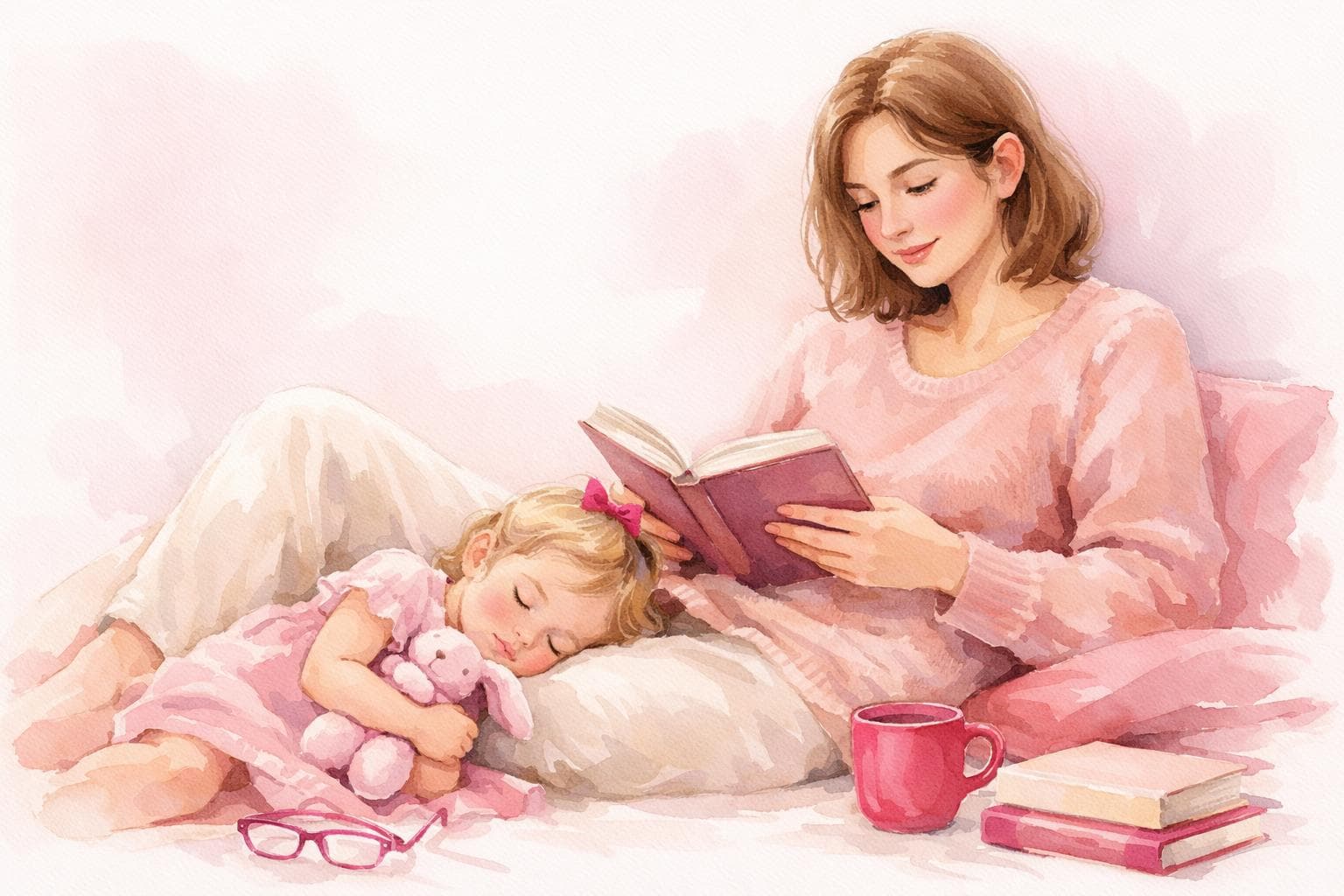
There is a pile of books on my bedside table that has been there for about two years. Some of them have bookmarks in them, which is optimistic. One of them I've started three times and can't remember where I got to, because too much happened between the second and third attempts and the thread of the story was lost somewhere around month four of the baby not sleeping.
If you used to be a reader and have somehow stopped being one, you are in extremely common company. Motherhood and reading have a difficult relationship, not because books stop mattering but because the conditions reading requires, a certain quality of attention, a stretch of uninterrupted time, the cognitive availability to follow a narrative across multiple sittings, are precisely what early parenthood dismantles.
Getting back to books is not complicated. But it does require letting go of the version of reading you used to do and finding the version that actually fits your current life.
Why reading matters more than it might seem right now
Before the practical part, the case for making the effort at all. Because for a lot of mothers, reading feels like a nice-to-have that keeps getting pushed down the list.
Reading fiction specifically has a well-documented effect on empathy. A 2013 study published in Science found that reading literary fiction improved participants' ability to understand other people's mental states, what psychologists call "theory of mind." For mothers navigating the emotional complexity of small children, partners and their own inner landscape, that particular capacity is one worth protecting.
Reading also does something that very little else in a depleted mother's day does: it requires the brain to inhabit a world that is not the one you are currently managing. Neuroscientist David Eagleman describes reading as one of the most cognitively immersive activities a human can engage in, engaging language processing, sensory cortex and narrative construction simultaneously. That immersion is the thing that makes reading feel restorative rather than merely entertaining. It is genuinely different from scrolling, which produces stimulation without depth and tends to leave people more depleted than before.
A 2009 study from the University of Sussex found that reading for as few as six minutes reduced participants' heart rate and muscle tension by up to 68%, outperforming other relaxation methods including listening to music and taking a walk. Six minutes.
Why moms stop reading and how to start again
The barriers are predictable and mostly practical rather than motivational.
Attention fragmentation. Reading requires a particular kind of sustained attention that is harder to access when your brain has spent the day context-switching between small urgent demands. The capacity is still there. It needs a settling period before it comes online.
The book pile guilt. The books you have not read become evidence of time you did not have, which can make looking at them feel worse rather than better. Starting fresh, with one book and no obligation to finish it, tends to work better than working through the pile.
The wrong format for this season. Hardback literary fiction that requires full attention is not the only kind of reading. Short story collections, essay anthologies, narrative non-fiction in chapters that work as standalones: these formats are much more compatible with interrupted reading time.
Choosing the phone first. This is partly habit and partly the lower activation energy of scrolling compared to reading. The phone is already in your hand. The book requires a choice.
How to build a reading habit that actually sticks
Strategy / What it looks like in practice
Replace one phone scroll session per day with ten minutes of reading. Before bed, during a feed or in the school pickup queue
Keep the book in the room where you'll read it. Not in another room, not in a bag: on the sofa, on the bedside table
Lower the bar for what counts. Two pages counts. One page counts. Reading the same paragraph twice counts.
Choose books that match your current attention span. Short chapters, propulsive stories, essay collections: these are not lesser books
Use audiobooks without guilt. Listening while doing the washing up, driving or walking is reading
Join something with accountability. A book club, an online reading community or even just a friend doing the same book
The audiobook point deserves a specific mention because many readers feel they don't count. They count. The cognitive and emotional benefits of narrative engagement apply regardless of whether the words enter through the eyes or the ears.
What reading does for the mother underneath the role
There is a version of this that is purely practical: reading is good for your brain, it reduces stress, it improves focus. All of that is true.
But the reason many mothers feel the loss of reading so specifically is not purely cognitive. It is because reading was, for a lot of people, one of the primary ways they inhabited their own inner life. It gave them access to other people's interiority in a way that quietly nourished their own. It was the activity in which they were most fully themselves, absorbed and alone and somewhere else entirely.
Getting that back, even imperfectly, even six minutes at a time, is not a small thing. It is a form of tending to the person who exists underneath the role.
"A reader lives a thousand lives before he dies. The man who never reads lives only one." - George R.R. Martin
If the broader question of reconnecting with who you were before children is part of what you're working through, how to feel like yourself again after kids approaches that from a wider angle. And if finding time for anything that is yours feels genuinely impossible right now, how to prioritise yourself without guilt addresses the internal obstacle that tends to come before the practical one.
Start with one book. Keep it somewhere visible. Open it tonight.
Further reading: Maryanne Wolf, Reader, come home: the reading brain in a digital world (2018). Alberto Manguel, A history of reading (1996). University of Sussex, reading and stress reduction research (2009).