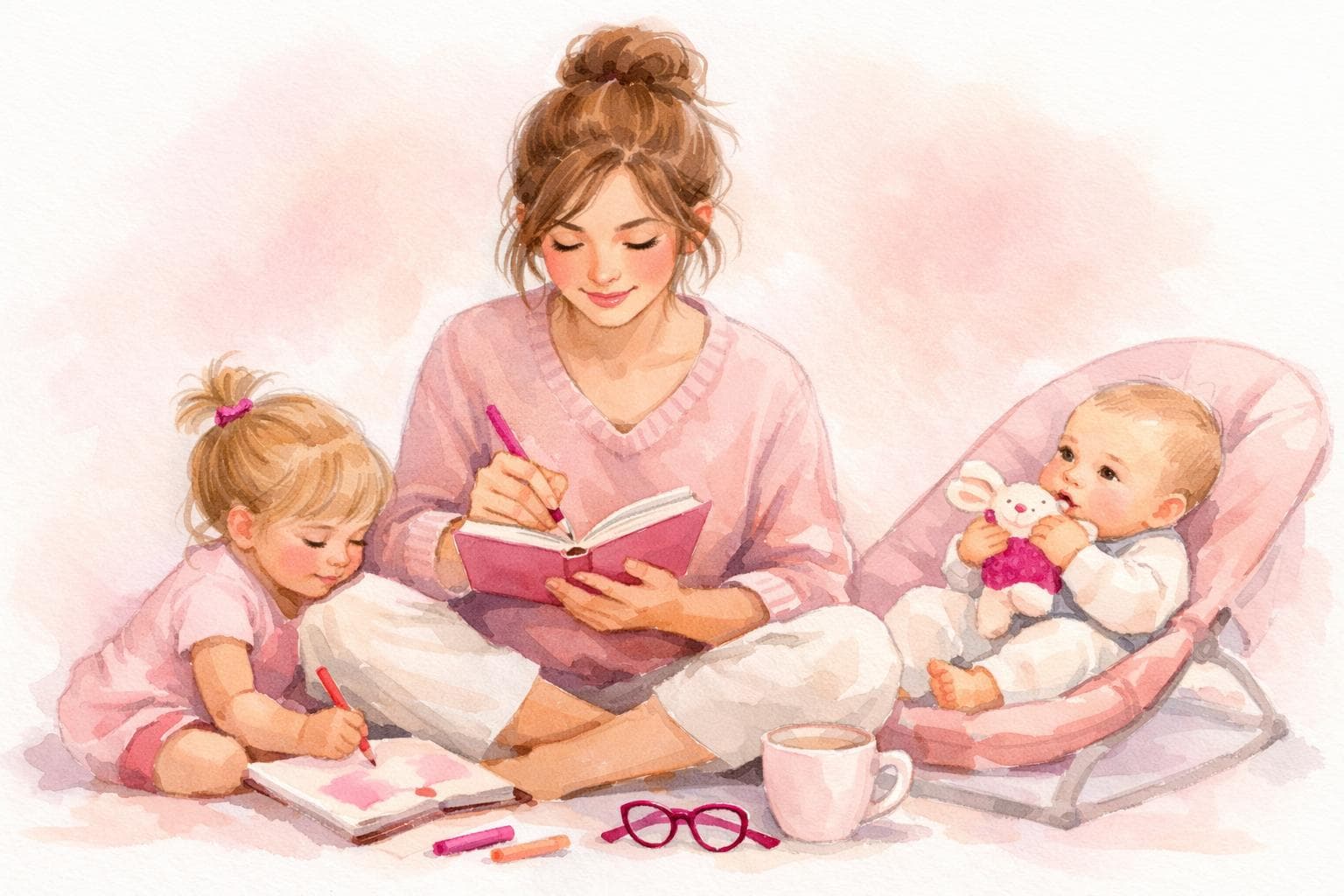
I bought a beautiful journal when my second child was about six months old. Thick pages, a proper cover, the kind that felt like a commitment. I wrote in it twice.
The problem wasn't motivation. It was the version of journaling I had in my head: a quiet morning, coffee going cold on the desk, thirty minutes of uninterrupted reflection. That version requires conditions that motherhood dismantled completely. So the journal sat there, looking reproachful, until I stopped seeing it at all.
What changed was lowering the bar so dramatically that it almost felt like giving up. A sentence. Sometimes two. Whatever I could fit into the thirty seconds between putting the baby down and one of the older kids calling from another room.
It was not what I imagined journaling would be. It was considerably more useful.
Why journaling is worth bothering with at all
Before we talk about how, it's worth being specific about why. Because "journaling is good for you" is the kind of advice that sounds fine and means nothing without the evidence behind it.
Psychologist James Pennebaker spent decades researching expressive writing and its effects on health. His studies, beginning in the late 1980s, consistently found that writing about difficult or emotionally significant experiences reduced symptoms of anxiety and depression, improved immune function and led to greater cognitive clarity around the experiences being processed. A 2018 meta-analysis in the Journal of Experimental Psychology confirmed the core finding: expressive writing, even in very short sessions, produces meaningful psychological benefits.
For mothers specifically, the value is not abstract. Motherhood involves an enormous amount of emotional experience that rarely gets articulated. The grief, the joy, the frustration, the confusion about identity, the moments that are beautiful and the ones that aren't: most of it goes unprocessed simply because there is no space for it. Journaling creates a small container for that material. It doesn't have to be long. It just has to be somewhere.
The version that actually works for mothers
The traditional journaling model assumes time, privacy and a certain emotional readiness. Mothers frequently have none of these in reliable supply.
What works instead tends to look quite different. Here are the formats that are actually compatible with real motherhood:
- The one-line journal. A single sentence about the day. One true thing, written before sleep or at whatever moment is available. It takes less than a minute and creates a record that is genuinely valuable over time. The app Day One or a simple notebook both work equally well.
- The brain dump. Five minutes, no structure, no editing. Everything that is sitting in your head transferred to a page in whatever order it arrives. The goal is not coherence. The goal is getting it out of your nervous system and onto paper, which Pennebaker's research suggests has measurable effects even when the writing is messy and unformed.
- The question journal. One prompt per session. "What am I carrying that I haven't named yet?" or "What do I actually want right now?" or "What would I tell a friend in my situation?" These questions work because they bypass the blank-page paralysis and give the writing somewhere to start.
- The voice memo disguised as journaling. If writing feels like one friction too many, speaking into your phone works on the same psychological mechanism. You are externalising internal experience. The format is secondary to the process.
- The gratitude note with teeth. Not just what went well, but what was hard and how you moved through it. Gratitude journaling without acknowledgment of difficulty tends to become performative. The version that actually builds psychological resilience is more honest than that.
How to actually start
This is where most journaling advice becomes unhelpful: it tells you to "make time" or "prioritise it" as though time is a resource you simply need to value more highly. Mothers do not have a time management problem. They have a genuine shortage of minutes that are not already claimed by someone else.
The practical approach is different. It involves attaching the journaling habit to something that already exists in your day, a concept behavioural scientist BJ Fogg calls habit stacking. The journal lives next to your bed and gets opened when you turn off the light. Or it lives in your bag and gets used in the car during school pickup while you wait. Or it's three sentences typed into the notes app on your phone during the two minutes before the chaos of the morning properly begins.
Time window | Journaling format that fits |
|---|---|
60 seconds before sleep | One sentence: one true thing about today |
5 minutes during nap or school hours | Brain dump, no structure |
Waiting in the car at pickup | Voice memo or three typed sentences |
Morning before the house wakes | One question prompt answered briefly |
At the end of a difficult day | What happened, how it felt, what I need |
The format matters less than the consistency. Even once or twice a week creates a practice that accumulates into something useful over time.
What you might find when you start
This is the part nobody mentions in the beginning. Journaling has a way of surfacing things you didn't know were there. Not in a dramatic way but in the small, slightly uncomfortable way of noticing: I keep writing about the same thing. Or: I'm angrier than I realised. Or: I miss something I haven't named until now.
That's not a problem with journaling. That's it working.
"I can shake off everything as I write; my sorrows disappear, my courage is reborn." - Anne Frank, The diary of a young girl
If what surfaces in the writing is something that feels bigger than a few journal pages can hold, How therapy can help moms who feel stuck is worth reading. Journaling and therapy work well in the same direction and are not in competition.
And if the motivation behind wanting to journal is partly about reclaiming a sense of self that has gone quiet in motherhood, How to feel like yourself again after kids approaches that question from a wider angle.
Start with one sentence. Tonight. That is a journaling practice. Everything else can follow from there.
Further reading: James Pennebaker, Opening up by writing it down (2016). Julia Cameron, The artist's way (1992). BJ Fogg, Tiny habits (2019).