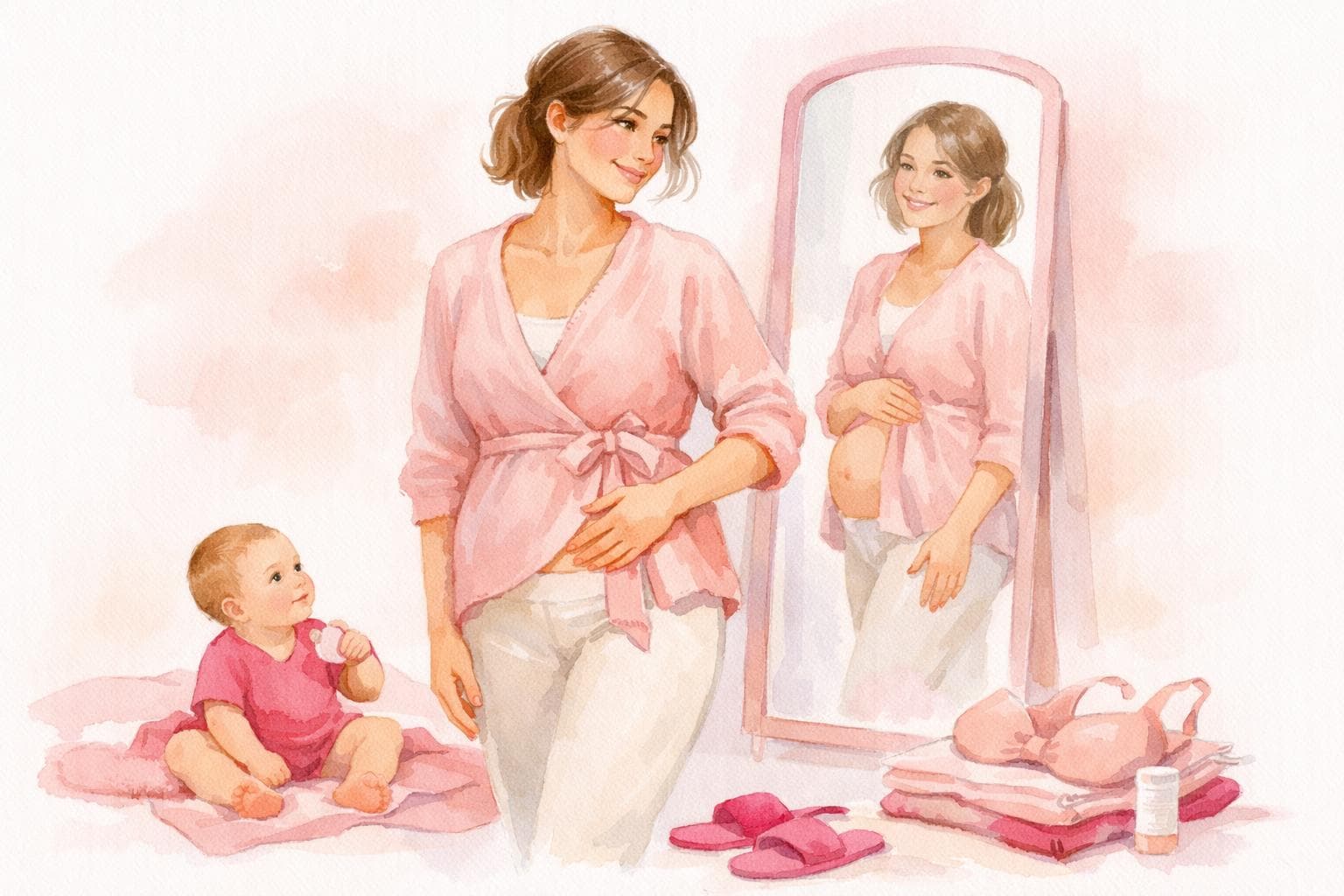
For about four months after having my baby I lived in the same three outfits. Not because I lacked clothes: my wardrobe was full of them. But none of them belonged to the body I was in. My pre-pregnancy clothes didn't fit. My maternity clothes felt like evidence of something I was supposed to be moving on from. And the gap between those two wardrobes was where I stood every morning, feeling worse about myself with each thing I pulled off a hanger and put back.
The postpartum wardrobe problem is rarely talked about as an actual problem. It gets absorbed into the broader conversation about "bouncing back," framed as temporary, treated as something that should resolve itself if you just wait long enough. But the reality of standing in front of a mirror every morning in clothes that don't fit, during a period when your relationship with your body is already fragile, is not nothing. It is a small but daily experience of feeling at odds with yourself.
Getting dressed should not feel like a confrontation. And with some practical reframing, it doesn't have to.
Why this matters more than it sounds
The connection between clothing and psychological wellbeing is more substantive than the "it's just clothes" dismissal suggests.
Professor Karen Pine, a psychologist at the University of Hertfordshire and author of Mind what you wear (2014), has researched how clothing affects mood, confidence and self-perception. Her work found that wearing clothes that felt comfortable and aligned with how a person wanted to feel produced measurable differences in confidence and performance. The inverse was also true: clothing that didn't fit properly or that evoked negative associations had a direct negative effect on mood.
For postpartum women, this matters specifically. A 2021 study published in Women's Health found that negative body image was one of the most consistent predictors of low maternal wellbeing in the first year postpartum, more consistently than sleep deprivation or social isolation in the samples studied. What you see in the mirror every morning contributes to that. Getting dressed is not a trivial part of the postpartum experience.
The mindset shift that makes everything else easier
Before the practical part, there is a reframe worth making.
Your postpartum body is not a before-and-after. It is not a transition state between the body you had and the body you're supposed to get back to. It is your body right now, and it is the body that did something significant. Dressing it well in this period is not giving up on change. It is refusing to put yourself on hold until change arrives.
The goal of getting dressed is not to look like you did before children. It is to put on clothes that make you feel like yourself, in whatever version of yourself you currently are, so that you can get through the day without the additional tax of feeling physically uncomfortable or visually at odds with your own reflection.
That is a completely achievable goal, and it does not require waiting until you are a different size.
What actually works, practically
Not trends. Not rules about what to wear at a certain size. These are the principles that tend to make the biggest practical difference:
Buy for the body you have right now. This is the most important one and the one most women resist. Wearing clothes that don't fit properly, in either direction, makes every body look and feel worse. A pair of jeans in your current size will always look better than a pair in a previous size that you're hoping to fit into again. This is not giving up. It is dressing competently for your current reality.
Prioritise fit and fabric over everything else. Clothes that pull, gape, ride up or constrain movement spend the day reminding you they're there. Soft fabrics that move with you, cuts that sit comfortably without requiring constant adjustment, these are not luxuries. They are the baseline for getting through a day without thinking about what you're wearing at all, which is the actual goal.
Keep it simple rather than aspirational. A few things that work together and that you reach for without hesitation are worth more than a wardrobe full of options that require energy to navigate. Three tops, two pairs of trousers, one dress: all of them fitting, all of them feeling good.
Consider access if you're breastfeeding. Wrap tops, button-fronts and stretchy necklines make feeding significantly easier and remove one layer of friction from an experience that already has enough of it.
A practical approach to rebuilding your wardrobe
What to keep. What to remove (for now). What to add
Anything that fits comfortably right now
Anything that requires your body to be different
One or two well-fitting basics in your current size
Clothes with stretch or give in the fabric
Rigid waistbands that compress or dig
A reliable pair of trousers or jeans that actually fit
Things that make you feel like yourself
Aspirational items that make you feel inadequate
Comfortable everyday tops that require no thought
Maternity pieces that still work (some will)
Items kept only as "motivation"
One thing that feels a little special and a lot comfortable
The "remove for now" column is not a bin. It is a separate storage space. You are not deciding the future. You are clearing the daily experience.
The mirror question
Mirrors are a site of judgment for a lot of postpartum women. The instinct is to avoid them. The more useful response is to shift what you're looking for when you look.
A body that carried a pregnancy, gave birth and is sustaining another person's life is doing things that have nothing to do with how it looks. Dressing it in clothes that fit is one way of acknowledging that it deserves the basic respect of being dressed properly, not in a holding pattern until it becomes something else.
"You are allowed to be both a masterpiece and a work in progress simultaneously." - Sophia Bush
If the mirror is generating more distress than the getting-dressed problem can explain, Body image after motherhood: learning to love yourself again takes a more sustained look at what's underneath that. And if the postpartum physical experience overall has felt harder than you were prepared for, How to feel confident in your body after kids approaches the confidence dimension specifically.
You deserve to get dressed every morning in clothes that fit. That is not a small thing. It is one of the simplest forms of treating yourself with basic care and it compounds.
Further reading: Karen Pine, Mind what you wear: the psychology of fashion (2014). Anuschka Rees, The curated closet (2016). Christy Harrison, Anti-diet (2019).