The problem with most home organisation advice is that it assumes a certain amount of available calm. A weekend free for sorting. A baseline of tidiness to work from. The kind of mental space that allows you to think about systems rather than just survival.
Most overwhelmed mothers don't have any of those things.
What they have is a kitchen where the counter is always full of things that don't belong there, a school bag that hasn't been fully unpacked since Tuesday and a vague, persistent sense that the house is working against them rather than for them. Not because they lack domestic skill or motivation. Because they are managing an enormous amount and the house has quietly accumulated the evidence of that.
Getting organised when you're already overwhelmed is not a matter of trying harder. It is a matter of starting differently.
Why the house matters for mental health
This is not about having a perfect home. The evidence for why a degree of order matters is specifically about cognitive load, not aesthetics.
A 2010 study published in Personality and Social Psychology Bulletin found that women who described their homes as cluttered or unfinished had higher cortisol levels throughout the day than women who described their homes as restful. The relationship between physical environment and stress response is not metaphorical. Clutter is processed by the brain as unfinished tasks. Every pile of things you pass is, at some level, registering as something you haven't done yet.
Psychologist and researcher Darby Saxbe, who led much of this research, noted that the effect was stronger for women than for men in heterosexual partnerships, which aligns with research showing that domestic environment is more consistently tied to women's emotional wellbeing than men's. The mess that everyone lives in is not experienced equally by everyone who lives in it.
This is not a reason to demand a perfect house from yourself. It is a reason to take seriously the idea that getting things to a manageable baseline is not a vanity project. It is a wellbeing issue.
The reason most attempts at organisation fail
Most people approach a disorganised home the way they approach a large task at work: they try to do all of it. They plan a full weekend, commit to a whole-house overhaul and then the weekend arrives and one of the children is ill, or they run out of time, or the scale of what they've committed to becomes paralysing and nothing happens at all.
The research on behaviour change suggests a different approach. Psychologist BJ Fogg, whose work on habit formation is foundational in the field, found that the single biggest predictor of sustained change was starting smaller than felt necessary. Not a weekend project. A single drawer.
This is the principle that actually works for overwhelmed mothers: not doing everything, but doing one specific small thing completely. Then another one. The momentum that comes from finishing something, even a very small thing, produces a different psychological state than the shame that comes from failing to finish something large.
Where to actually begin
Not with the worst room. Not with the thing that requires the most decisions. Start where the friction is highest in your daily life.
For most mothers that is one of the following:
- The morning bottleneck. Wherever the chaos of getting out of the house concentrates: shoes, school bags, permission slips, keys. A small zone near the door with a hook for each child's bag and a basket for outgoing items can reduce the morning stress significantly.
- The kitchen counter. Clear surfaces are easier to keep clear than cluttered ones. The counter accumulates because it's a default landing space. A box that lives somewhere nearby for "things that need to go elsewhere" contains the spread without requiring decisions about each item in the moment.
- The laundry cycle. Not washing it; most people manage that. The folding and returning that stalls and becomes a permanent feature of the sofa. A basket system that sorts as it comes out of the dryer removes one decision layer from a task that defeats many people at the final stage.
A realistic approach to the bigger picture
Area. The minimum viable version. What it actually fixes
Entrance/hallway
One hook and one basket per person
Reduces morning chaos
Kitchen surfaces
One clear space that stays clear
Reduces cognitive load every time you enter the room
Children's toys
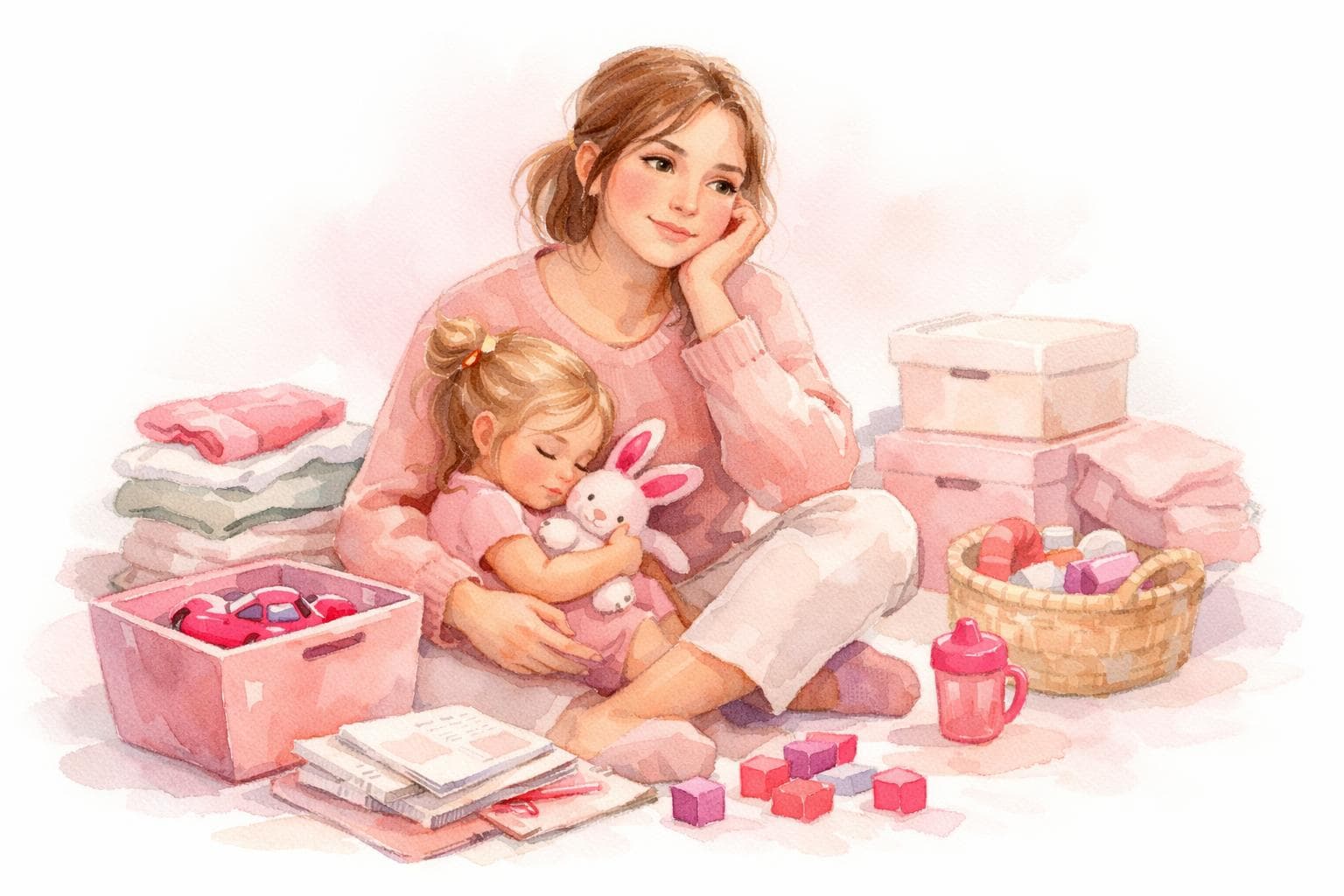
One container rule: toys live in containers, not loose on floors
Easier tidy-up, less visual noise
Laundry
Sorting baskets at the source
Removes one decision from an already effortful process
Paperwork
One physical inbox and a weekly ten-minute sort
Stops important things disappearing into piles
None of this is aspirational. It is functional which is the correct standard for a home that contains children.
The mental load connection
Getting the house to a manageable state is also in part a mental load issue. The invisible labour of tracking what needs to be done, deciding where things go and noticing what has run out is disproportionately carried by mothers. Systems don't just reduce physical clutter. They reduce the number of decisions that have to be made on the fly, which is where a significant portion of that invisible labour lives.
A labelled shelf doesn't require you to remember where things go. A routine for emptying the school bags means you don't have to decide whether to do it. Taking decisions out of the daily loop is one of the most underrated forms of reducing mental load.
If that invisible labour is something you're navigating in your household more broadly, The invisible mental load moms carry every day addresses it with more depth than there is space for here.
The permission you didn't know you needed
You do not need to wait until you have the time to do this properly. You do not need the right storage solutions, a clear weekend or an organised mind to begin. You need ten minutes and one specific place to start.
"You don't have to see the whole staircase. Just take the first step." - Martin Luther King Jr.
The house does not need to be a project. It needs to be a place you can function in. That standard is achievable and worth working toward, not as a domestic ideal but because a home that works for you makes everything else slightly more possible.
If the overwhelm goes beyond the physical state of the house and into how you're managing everything at once, Emotional exhaustion in motherhood: what it really means is worth reading. Sometimes the disorganised house is a symptom rather than the problem.
Start with the entrance. Or the counter. Or the laundry basket. One thing. Today.
Further reading: BJ Fogg, Tiny habits: the small changes that change everything (2019). Dana K. White, Decluttering at the speed of life (2018). Greg McKeown, Essentialism: the disciplined pursuit of less (2014).