
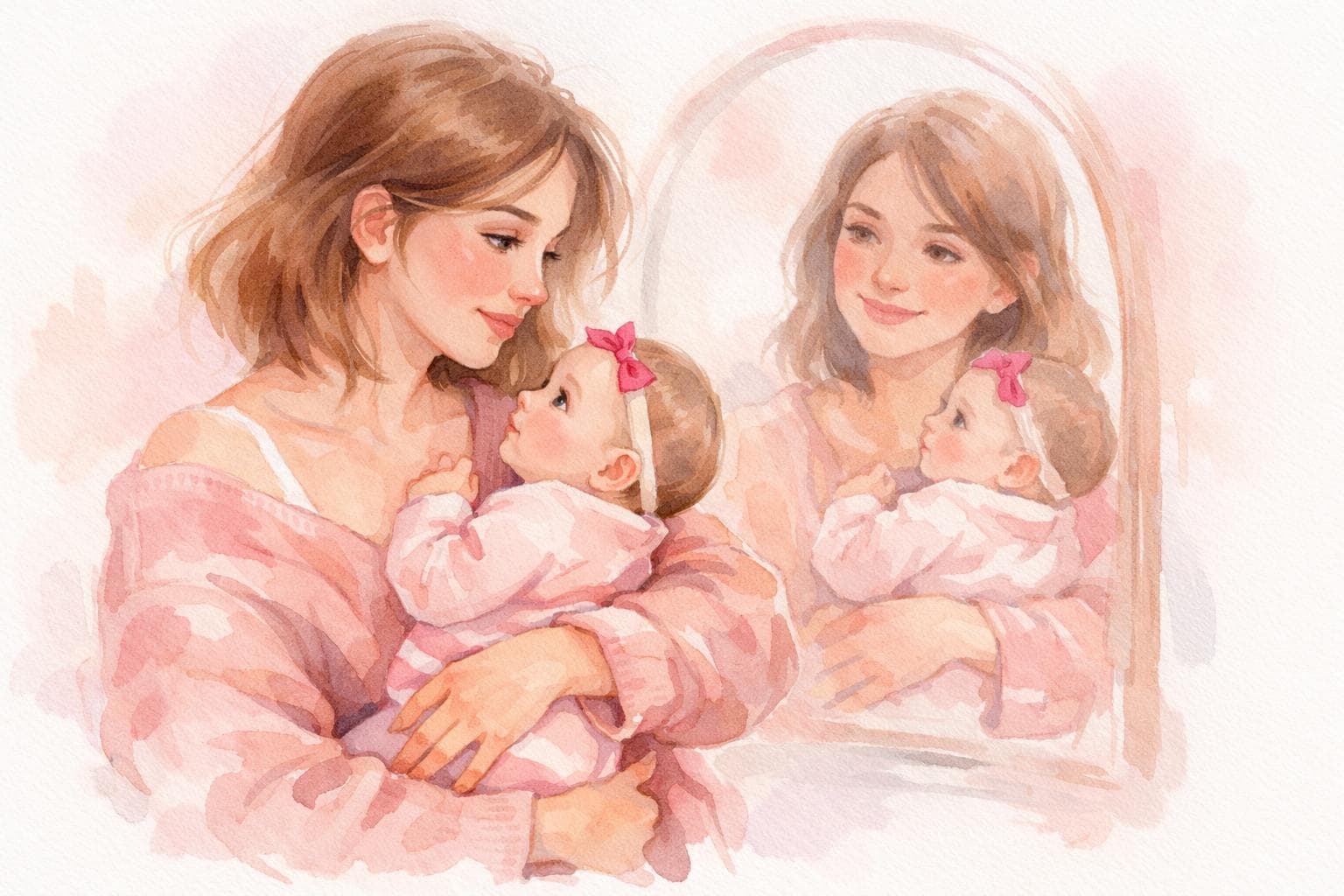
There's a particular moment that many mothers describe — usually somewhere in the first year. You catch yourself in a mirror, or someone calls your name in a way that belongs to a different chapter of your life, or you hear a song that used to mean something specific to you. And for just a second, you don't quite know who you are looking at. Not because anything is wrong. Because something has genuinely changed.
Motherhood reshapes the way you see yourself in ways that are hard to prepare for, harder to describe to someone who hasn't been through it, and almost entirely absent from the conversation we have before it happens. This article is an attempt to name some of it honestly.
There's Actually a Word for This
The transformation of becoming a mother has a name: matrescence. Coined by anthropologist Dana Raphael in 1973 and later expanded by Dr. Aurélie Athan at Columbia University, it describes the developmental passage into motherhood — a shift that is biological, neurological, psychological, and social, all at once.
The comparison most researchers reach for is adolescence. Just as adolescence transforms a child into an adult — through hormonal upheaval, identity renegotiation, and a wholesale revision of relationships and priorities — matrescence does something similar, just decades later and with the added dimension of being entirely responsible for someone else.
Research published in Trends in Cognitive Sciences (Orchard, Rutherford, Holmes & Jamadar, Yale & Monash University, 2023) confirmed what many mothers already knew intuitively: the maternal brain undergoes measurable structural reorganisation during this period, comparable in scope to what happens during adolescence. Areas responsible for social cognition, emotional processing, and attunement to others are literally reshaped. This isn't metaphorical. The woman who emerges from early motherhood has, in some neurological sense, a different brain from the one who entered it (PMC, 2024).
"Becoming a mother is a major life transition involving dramatic changes to a woman's brain, body, relationships, societal roles, and identity. This shift necessitates significant psychological and social adjustments, which can challenge mothers' self-perception and confidence." — Maternal Health, Neonatology and Perinatology (PMC, 2025)
The Specific Ways Your Self-Perception Shifts
The change doesn't land evenly or all at once. It tends to arrive in different places at different times — and looks different for different women. But researchers have identified some consistent patterns:
Priorities reorganise, often without your conscious decision. Things that felt urgent before — ambitions, aesthetics, social obligations — can suddenly feel negligible. And things that never felt particularly central — safety, continuity, your child's inner life — can become all-consuming. According to the PMC concept analysis of motherhood transition (2022), this shift in what matters is one of the defining attributes of the transition: not just acquiring new responsibilities, but genuinely reordering what has meaning.
The self fragments before it integrates. Researchers studying this process consistently describe an early phase characterised by what Laney and colleagues (Biola University, 2015) called "fracturing identities" — a period when the previous self has begun to dissolve but a new, integrated identity hasn't yet formed. This is the disorienting in-between place that many mothers inhabit for months or years. The confusion is not a sign of failure; it's structurally predictable.
Your relationship to ambition and achievement often changes. Some mothers find that career pursuits feel more meaningful, anchored in something larger than themselves. Others find them temporarily or permanently less urgent. Research consistently shows that this isn't uniform — and that both are valid responses to a seismic shift in what "success" means to you.
How you hold imperfection changes. For many mothers, becoming responsible for a child forces an encounter with limitation that they've managed to avoid before. You cannot control everything. You will sometimes get it wrong. How you relate to that reality — whether you collapse into shame or develop something more like equanimity — often changes fundamentally through motherhood.
Here's how self-perception commonly shifts across different dimensions:
DimensionBefore motherhoodAfter — common patterns
Core identity
Defined by career, relationships, interests
Redefined; motherhood becomes central, but may crowd out other aspects
Relationship to the body
Largely aesthetic or functional
More complex; associated with birth, feeding, physical transformation
Values hierarchy
Often diffuse or implicit
More crystallised; priorities clarify under pressure
Relationship to imperfection
Managed through control
Forced to adapt; perfectionism becomes harder to sustain
Social identity
Who you are to yourself
Increasingly shaped by who you are in relation to your child
The Grief Nobody Mentions
One of the more surprising dimensions of this shift, for many mothers, is the grief. Not grief about the baby or the experience — but grief for the version of themselves that no longer exists in quite the same form.
This is often unnamed because it feels ungrateful, or incompatible with loving your child. But research is clear: mothers frequently experience a genuine sense of loss during matrescence, even when they wouldn't undo the experience for anything. Motherhood research consistently describes this as "disenfranchised grief" — loss that doesn't get socially acknowledged or mourned because it doesn't fit a culturally recognisable category.
A Motherly State of Motherhood survey (2020) found that 71% of moms reported being "most strongly defined" by their motherhood — a statistic that tells you both how transformative the shift is and how completely it can absorb the identity that came before.
Acknowledging this grief — sitting with it rather than explaining it away — tends to be a more useful response than denial. It coexists with love. The two aren't in competition.
What This Doesn't Mean
It doesn't mean you've lost yourself permanently, or that the woman you were has been replaced rather than expanded. Research on women who've come through the acute phase of this identity transition consistently describes an addition, not an erasure — a self that is more complex, more connected, and often more clear about what matters than the one that existed before.
It also doesn't mean all the change is hard. Researchers studying motherhood and identity find that many mothers describe expanded empathy, sharper priorities, a deeper relationship with their own values, and a sense of purpose that's harder to manufacture before having children. The fracture isn't the end of the story.
If the sense of not recognising yourself feels persistent, heavy, or has started to affect your mental health, it's worth naming that specifically — there's a difference between the normal disorientation of matrescence and something that warrants support. Both are valid. And understanding why motherhood feels so overwhelming is often part of the same inquiry as understanding who you're becoming inside it.
The woman looking back from that mirror isn't a stranger. She's just further along a process than anyone told you to expect.
Further reading: Identity loss after becoming a mother — and how to find yourself again | How to reconnect with yourself after motherhood | What no one tells you about early motherhood | How to deal with mom guilt without blaming yourself