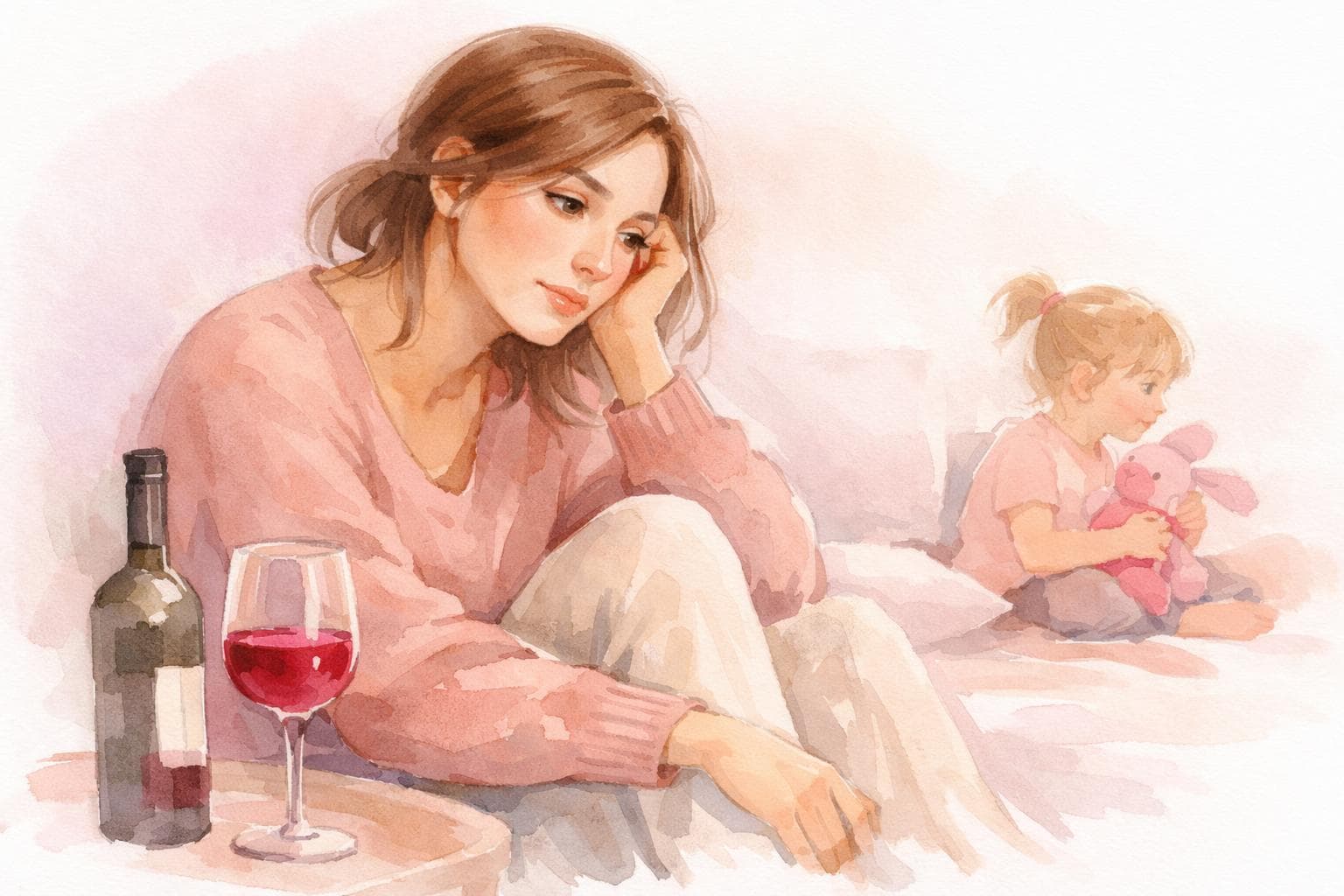
"Mummy needs wine" has become shorthand for the particular exhaustion of motherhood. It's on mugs and tea towels and birthday cards. It's a shorthand that is, on some level, genuinely understood. The end of a hard day with small children really is hard. The desire for something that takes the edge off is entirely human.
But somewhere between the joke and the reality is a conversation that most people find easier not to have. Because for a significant number of mothers, the glass of wine at the end of the day is not a joke. It is a habit that has quietly grown. And because alcohol is legal, social and woven into the fabric of adult life in a way that makes it very hard to examine without feeling like you're being dramatic about something everyone does.
This is not a piece about alcoholism. It is a piece about something more ordinary and more widespread: the relationship between alcohol, maternal mental health and the cultural normalisation of drinking as a coping mechanism for the specific stresses of motherhood.
What the research shows about moms and alcohol
The numbers on this have shifted significantly in recent years, and not in a reassuring direction.
A 2020 report from the RAND Corporation found that alcohol consumption among women with children increased by 17% during the pandemic period, compared to 7% in childless women. This was not a transient spike. A 2022 study published in Drug and Alcohol Dependence found that problem drinking in mothers of young children had risen significantly over the preceding decade, with stress, anxiety and social isolation identified as the primary drivers.
In the UK, the Office for National Statistics reported that women in their 30s and 40s, the demographic most likely to have young children, showed the sharpest increases in regular drinking over the last two decades. And yet the cultural conversation around maternal drinking tends to oscillate between the wine-mum joke and the dramatic cautionary tale, with very little honest engagement with the vast middle ground where most people actually live.
How alcohol interacts with maternal mental health
Alcohol is a depressant. This is not a moral statement. It is a pharmacological description of what it does: it temporarily suppresses the central nervous system, producing the sensation of relaxation and reduced anxiety.
The problem is what comes next.
As alcohol is metabolised, it produces what researchers call a "rebound effect": an increase in anxiety, cortisol and sympathetic nervous system activation that tends to arrive in the early hours of the morning. The sleep disruption this produces is well documented. A 2020 study in Alcoholism: Clinical and Experimental Research found that even moderate alcohol consumption, one to two drinks in the evening, significantly disrupted sleep architecture, reducing restorative deep sleep and REM sleep. For mothers who are already sleep-deprived, this compounds an existing deficit.
More significantly, alcohol is bidirectionally related to anxiety. People with anxiety are more likely to drink. Drinking increases anxiety over time. The short-term relief it provides is real. The longer-term effect on the anxiety it was intended to manage is the opposite of what most people intend.
A 2019 systematic review in the British Medical Journal found a consistent association between regular alcohol consumption and increased rates of depression and anxiety in women, with the relationship stronger in women than in men. For mothers who are already navigating elevated mental health risk in the postpartum and early parenting period, this is a relevant finding.
The signs that the habit has become something worth examining
Not a clinical checklist. A set of honest questions.
- Are you drinking most evenings, and finding it hard to have a night without?
- Is the amount you drink gradually increasing to produce the same effect?
- Do you feel more anxious, irritable or flat on mornings after drinking?
- Do you find yourself looking forward to the first drink earlier in the day than you used to?
- Has drinking become the primary way you decompress from the stress of parenting?
- Have you ever felt uncomfortable when someone mentioned how much you drink?
None of these individually constitutes a problem diagnosis. Together they describe a pattern worth examining honestly, preferably with someone who is not going to either minimise it or catastrophise it.
What helps instead (without pretending it's simple)
What alcohol does | What addresses the same need more sustainably |
|---|---|
Produces temporary relaxation | Physical movement, particularly in the evening |
Reduces anxiety briefly | Genuine rest, not stimulated rest |
Signals the end of the working day | A consistent transition ritual that doesn't involve alcohol |
Provides adult social connection | Friendships that don't depend on drinking as the context |
Takes the edge off | Identifying what the edge is and addressing it more directly |
The last row is the important one. Alcohol takes the edge off, but it does not address what the edge is. The exhaustion, the resentment, the loneliness, the lack of space in the day that is genuinely yours: these are the things that drive the reach for a drink, and they are also the things that get harder to address the more reliably the drink is providing short-term relief.
If the exhaustion is the primary driver, sleep strategies for moms (that have nothing to do with the baby) is worth reading. If loneliness and the absence of genuine adult connection is part of what's underneath it, loneliness in motherhood: why it happens and how to find connection addresses that directly.
A note on getting support
If this piece has landed uncomfortably, that is worth paying attention to rather than dismissing.
Talking to a GP about your drinking is not the same as being referred to treatment. It is the beginning of a conversation that can range from practical advice to assessment to signposting to support, depending on what the conversation reveals.
In the UK, Drinkaware offers confidential support at www.drinkaware.co.uk. In the US, the SAMHSA National Helpline is available at 1-800-662-4357.
"The curious paradox is that when I accept myself just as I am, then I can change." — Carl Rogers
Examining your relationship with alcohol is not a judgment. It is a form of self-knowledge. And self-knowledge, for mothers specifically, tends to be the beginning of everything that helps.
Further reading: William Porter, Alcohol explained (2015). Annie Grace, This naked mind: control alcohol (2018). Drinkaware UK: www.drinkaware.co.uk.