
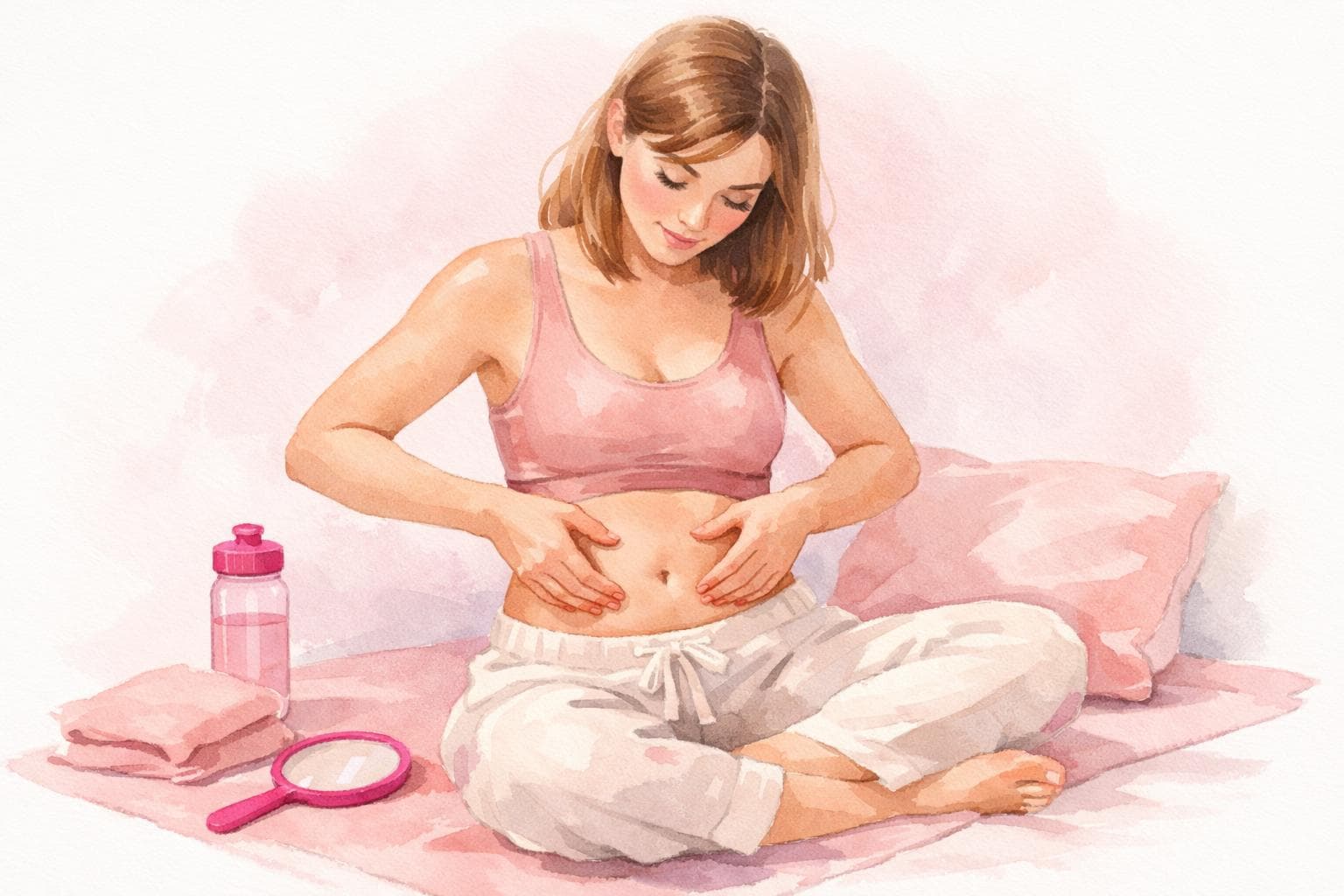
You still look four months pregnant, and the baby is fourteen months old. Every crunch tutorial online makes it worse, not better. You have started avoiding mirrors at a certain angle, and nobody at your six-week check actually checked for this, they just glanced and said everything looked fine. It might not be. And there is a real, thirty-second way to find out for yourself.
Diastasis recti is a separation of the rectus abdominis, the "six-pack" muscles, along the midline connective tissue called the linea alba, most commonly caused by the sustained abdominal stretching of pregnancy. It affects up to 60% of women during pregnancy, with 39% still showing a measurable gap at 6 months postpartum, according to Radiant Pelvic Health's February 2026 clinical guidance. By 12 months, roughly 36% of women still have a measurable separation, per a 2026 review published by ScienceInsights, and the most significant natural recovery window closes around the first eight weeks after delivery, after which spontaneous healing largely plateaus without targeted work. This guide covers exactly how to check yourself at home, what the results actually mean, and where real healing starts from there.
For the broader picture of physical postpartum recovery centred on function rather than appearance, our guide to postpartum recovery programs for moms who hate diet culture covers that adjacent ground.
How to actually check yourself step by step
- Lie on your back, knees bent, feet flat on the floor.
- Place one hand behind your head for light support, and position the fingers of your other hand, palm down, directly on your belly button.
- Press your fingertips gently but firmly into your abdomen, pointing down toward your spine.
- Lift your head and shoulders slightly off the floor, as if beginning a small crunch, keeping your fingers in place.
- Note the width: how many fingertips fit sideways into the gap between the two muscle bands.
- Note the depth and texture: whether your fingers sink in easily with little resistance, or meet firm, taut tissue.
- Repeat at two more points: roughly three finger-widths above your belly button, and three below it, since the separation can vary in width along the midline.
This whole check takes about 30 seconds, and it is worth doing at the belly button first, then above and below, rather than checking only once.
What your results actually mean
Gap width | What it generally indicates |
|---|---|
One finger-width or less | Considered within typical range |
Two finger-widths | Borderline; worth monitoring |
Roughly two and a half finger-widths, about 2cm, or more | Generally considered diastasis recti |
Fingers sink in with little resistance | Suggests more significant stretching of the connective tissue, regardless of width |
Firm, taut tissue even at a noticeable width | A comparatively milder presentation than the width alone might suggest |
Every Mother's clinical guidance adds an important caveat if you carry extra abdominal weight: press firmly into your midline, and know that the most accurate reading comes right as your head lifts about an inch and the muscles first begin to grab the sides of your fingers, not before or after that exact moment.
The gap width is only part of the story, according to Dr. Danaya Kauwe, a pelvic floor physical therapist writing for Radiant Pelvic Health. The tension and depth of the tissue in the gap matters just as much, if not more, than the raw number of fingers that fit inside it.
Self-check vs clinical assessment
At-home finger test | Physical therapist assessment | |
|---|---|---|
Time required | 30 seconds | Full session, 30 to 60 minutes typically |
What it measures | Approximate width and rough tension at a few points | Precise width, depth and tension at multiple points along the entire midline |
Includes functional assessment | No | Yes: breathing pattern, deep core activation, pelvic floor function, movement quality |
Best used for | A first indication of whether further evaluation is worth pursuing | Building an actual treatment plan |
Frequency recommended | No more than every 2 to 3 weeks, since checking is mildly stressful to healing tissue | As recommended by your provider |
A pelvic floor physical therapist's full assessment typically includes measuring gap width, depth and tension at multiple points, evaluating how your deep core activates, how you breathe, how you move, and how your pelvic floor functions, according to Dr. Kauwe, since the pelvic floor and deep core operate as one connected system, not two separate problems.
What actually helps and what to skip early on
Breathing and activation retraining comes before any strengthening work in a proper rehabilitation protocol, according to Dr. Kauwe: retraining how you breathe and how your deep core engages is the foundation everything else is built on, not an optional warm-up. Traditional crunches, sit-ups and full planks are generally not recommended early in recovery, per PelvicSense's 2026 guidance, though the evidence on crunches specifically is evolving: recent research suggests they may not worsen diastasis recti as previously assumed, but they need to be introduced at the right time in the healing process, not as a starting point.
"It is never too late to rehab a diastasis. Women see improvement even years after their last pregnancy." - Dr. Danaya Kauwe, PT, DPT, Radiant Pelvic Health (2026)
A 2025 pilot study on telerehabilitation for postpartum diastasis recti, registered on ClinicalTrials.gov and conducted through the University of Patras, tested a 12-week structured trunk stabilisation program delivered remotely, tracking inter-recti distance, trunk muscle endurance and body image alongside user satisfaction, evidence that structured, progressive programs, not random ab workouts, are where the actual research attention is going.
When to see a professional instead of waiting it out
- The gap measures two or more finger-widths, especially with little resistance when pressed
- A visible midline bulge or "pooch" persists even after weight has stabilised
- Ongoing lower back pain that has not resolved with general postpartum recovery
- Pelvic floor symptoms, leaking urine when you sneeze, cough or jump, occurring alongside the abdominal separation
- Doming or a ridge along the midline appears specifically during crunches or similar core exercises
Key takeaways
- Diastasis recti affects up to 60% of women during pregnancy, with 39% still measurable at 6 months and roughly 36% at 12 months postpartum, meaning it is common, not a personal failure of effort or discipline.
- The 30-second finger test checks width, depth and tissue tension at three points along the midline, and a gap of roughly 2cm or more, or tissue that sinks in with little resistance, generally indicates diastasis recti.
- Gap width alone does not tell the full story. Tension and depth of the connective tissue matter just as much as how many fingers fit into the separation.
- Breathing and deep core activation retraining comes before strengthening exercises in proper rehabilitation, not after, according to pelvic floor physical therapy guidance.
- It is never too late to address diastasis recti. Women see measurable improvement even years after their last pregnancy, making a late start a genuine option, not a missed window.
Sources and further reading
- Radiant Pelvic Health. (2026). Diastasis recti self-test at home. Dr. Danaya Kauwe, PT, DPT, PRPC. radiantpelvichealth.com
- ScienceInsights. (2026). Do I have diastasis recti? Take this self-check quiz. scienceinsights.org
- Every Mother. (2025). Diastasis recti test: how to check for diastasis recti on your own. every-mother.com
- PelvicSense. (2026). How to tell if you have diastasis recti: easy self-care. pelvicsense.com
- Biology Insights. (2025). How to test for diastasis recti: a self-check at home. biologyinsights.com
- Feasibility and Preliminary Efficacy of a Telerehabilitation Intervention for Diastasis Recti Abdominis: A Pilot Study. (2025). University of Patras, PMC, ClinicalTrials.gov NCT07017309. ncbi.nlm.nih.gov