This is an updated version of the live article at mom-bloom.com/articles/building-your-village-as-a-single-mom-a-practical-guide, with new 2025-2026 research added throughout to keep the piece current.
The phrase "it takes a village" was never meant as a decorative sentiment on a nursery wall. It was a description of how humans actually survive raising children. Nobody was supposed to do this alone.
And yet here you are. Doing it alone. Or close enough to alone that the distinction barely feels relevant at 2am when the baby has a fever and you have to be at work in five hours and there is nobody on the other side of the bed to tap.
The village is not something that appears. It is something you build. Deliberately, imperfectly, over time. And for single mothers, building it is not optional. Research is consistent on this point: it is one of the most protective investments you can make for your own mental health and for your child's wellbeing.
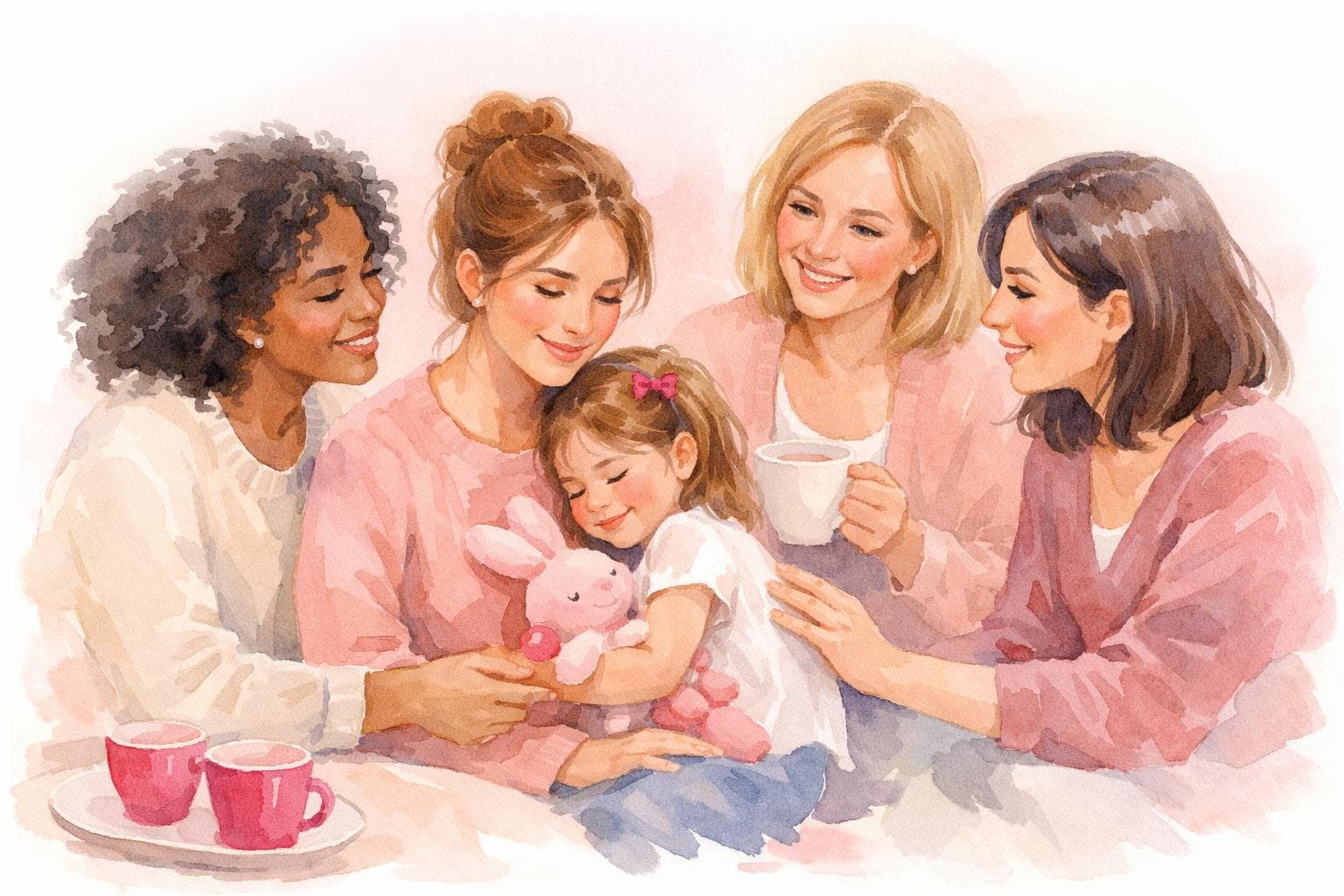
A support village for a single mom is a deliberately constructed network of people who provide emotional, practical and social support across different contexts: family, friends, neighbours, community organisations and online communities. A 2022 study published in ScienceDirect, based on a sample of 200 single mothers, identified four distinct support profiles: kinship network, friendship network, socially isolated and widely connected. The widely connected profile, drawing on both family and friends, consistently produced the most positive outcomes for parenting and mental health. The socially isolated profile carried the highest risk. A November 2025 national survey by the American Psychological Association found that 54% of US adults report feeling isolated, 50% feel left out and 50% feel they lack companionship often or some of the time, confirming that the isolation single mothers experience sits inside a much larger, currently worsening national pattern, not a private failure. The lesson is direct: the source of support matters, and more than one source is significantly better than one.
Why single moms are more isolated than they should be
Isolation is not a personality trait. It is a structural outcome.
When you are the only adult in the household, every logistical task rests on you. You cannot leave the child to run an errand without planning it. You cannot attend an evening event without childcare. Social invitations designed for couples feel complicated. Work friendships fade when your schedule is less flexible. Pre-existing friendships shift after a separation or divorce.
A 2025 sociological review published in BCPHR found that single mothers are more likely to experience heightened stress, depression, anxiety and social isolation than their married counterparts. The same review noted that limited community support is one of the three leading burdens single mothers carry alongside general stress and depression.
A 2025 scoping review on perinatal loneliness, conducted under the World Health Organisation's Commission on Social Connection (2024-2026), found that the perinatal period carries an elevated risk of loneliness for parents specifically, a risk that is further heightened by intersecting factors such as low income, LGBTQ+ identity, or belonging to a minoritised community. The same review confirmed that perinatal loneliness is directly associated with perinatal mental illness, with effects that can last well beyond the infant and toddler years for both parent and child.
The starting point is not willpower or optimism. It is a clear-eyed look at what kind of support you actually need and where it is most likely to come from.
"Social support theory explains that emotional and informational support from others helps individuals cope with stress. Creating supportive environments for single mothers can significantly improve their mental health and parenting abilities." - Penn State Applied Social Psychology, citing Gruman et al. (2024)
The four types of support you need
Not all support does the same thing. A 2022 ScienceDirect study found that family support and friend support serve different functions for single mothers, and only friend support predicted fewer internalising symptoms (anxiety and depression). Family support augmented friend support but could not replace it.
Type of support | What it provides | Best sources |
|---|---|---|
Emotional support | Validation, listening, witnessing; the feeling of being understood | Close friends, therapist, peer groups of other solo moms |
Practical support | Childcare coverage, meals, school runs, help during illness | Family, trusted neighbours, reciprocal parent networks |
Social support | Adult connection, shared experience, reduced loneliness | Friends without children, parent groups, community organisations |
Informational support | Advice, resources, referrals | Paediatrician, school community, online groups, professionals |
The mistake most single mothers make is relying on family for everything. Family is often willing and available. But family cannot provide the peer understanding that comes from someone living the same experience. And family systems carry their own dynamics, obligations and limits.
Where to find your village, layer by layer
Layer 1: existing relationships worth reactivating
Before building new connections, audit what already exists. Who used to be in your life before everything got compressed? Old friends who drifted. Neighbours you never properly met. A colleague you always meant to get coffee with.
Reactivating a dormant connection is easier than building a new one. A single honest message often does it: "Life got chaotic for a while. I miss talking to you. Can we find a time?"
Layer 2: other single parents
This is the most underutilised resource in most single mothers' lives. Other single parents understand the specific texture of the experience in a way nobody else fully can. They are also the most likely source of reciprocal practical support: the childcare swap, the school run trade, the "I'll cover Monday if you cover Friday."
Where to find them:
- School or daycare parent communities
- Single parent Facebook groups specific to your city or neighbourhood
- Meetup.com (search "single parents" or "solo moms")
- Peanut app (designed for mothers to find community)
- ESME (Empowering Solo Moms Everywhere)
Layer 3: community organisations
Many US cities have formal support programmes for single mothers that most eligible women never access. These include:
- Jeremiah Program: supports single mothers through post-secondary education with housing, childcare and mentoring; operates in ten US cities
- YWCA: single mother programmes vary by location; many offer childcare, counselling and community groups
- Head Start and Early Head Start: free early education programmes that also build parent communities (see our financial help guide for eligibility)
- Local churches, mosques and temples: regardless of religious affiliation, many faith communities run practical support for single-parent families
- Libraries: parent groups, free programming and a consistent community space that requires no spending
Layer 4: online communities
For single mothers in rural areas, or those whose schedules make in-person connection nearly impossible, online communities fill a real gap. A 2024 study by Dunham and colleagues found that when single mothers were given access to an online platform to share experiences and gain support, their sense of community significantly improved.
Online options worth exploring:
- r/SingleParents on Reddit: active, honest and largely supportive
- Peanut: designed specifically for mothers finding community
- ESME.com: peer-written resource specifically for solo mothers
- Single Mom Strong on Facebook: large US-based group
What the newest national data says about isolation right now
The APA's November 2025 Stress in America survey, based on a nationally representative sample of 3,199 US adults, found that more than six in ten adults report societal division as a significant source of stress, and that among those adults specifically, 61% also report feeling isolated, compared with 54% of all adults surveyed. The CDC's own updated 2026 guidance on community and connection continues to cite the 2023 Surgeon General's advisory on loneliness as the framework driving current public health attention to this issue, confirming that isolation has moved from a private struggle to a formally recognised national health concern.
This context matters for single mothers specifically: you are navigating a structural challenge that public health bodies now treat as a measurable crisis, not a personal shortcoming to solve quietly on your own.
What the research confirms | Detail |
|---|---|
US adults reporting isolation, general population | 54%, per APA's November 2025 survey |
US adults reporting feeling left out | 50% |
US adults reporting a lack of companionship | 50% |
Isolation among adults citing societal division as a stressor | 61% |
Perinatal loneliness risk factors identified by WHO's 2024-2026 Commission | Low income, LGBTQ+ identity, belonging to a minoritised community |
Building vs maintaining: the part nobody mentions
Building a village is not a one-time project. It requires maintenance. Friendships fade without contact. Reciprocal arrangements fall apart without communication. The person you leaned on during year one of single motherhood may not be the right person for year five.
Three habits that keep the village intact:
- Be explicit about what you need. Vague requests get vague responses. "Could you pick her up from school on Thursdays?" is more likely to be answered than "I could use some help."
- Give what you can when you can. Reciprocity does not have to be identical to be real. You cannot offer childcare swaps every week, but you can drop a meal off, send a voice note or remember someone's hard day.
- Stay connected even when things are fine. The village built only in crisis is the village you cannot rely on in crisis.
If asking for help still feels uncomfortable, that is worth examining separately. And if the loneliness has crossed into something that feels more like depression, our guide to emotional exhaustion in motherhood describes the specific kind of depletion that single mothers are most vulnerable to. Our single parenting honest guide also addresses the emotional realities that most practical guides skip.
The village you build for yourself is the one your child grows up in
Your child is watching how you navigate difficulty. They see whether you ask for help or suffer alone. They learn from your friendships what friendship looks like. They absorb your relationship to community as their baseline for what community is.
Building your village is not just self-care in the personal sense. It is a model for how to live.
Key takeaways
- The widely connected profile, drawing on both family and friends, produced the best mental health and parenting outcomes for single mothers in a 2022 study of 200 mothers. Socially isolated mothers had the worst outcomes.
- A November 2025 APA national survey found 54% of US adults feel isolated, 50% feel left out, and 50% feel they lack companionship, confirming that the isolation single mothers face reflects a broader, currently worsening national pattern.
- Friend support and family support serve different functions. Only friend support predicted fewer internalising symptoms. Family augments friends but cannot replace them.
- A 2025 WHO-affiliated review found perinatal loneliness risk rises further with low income, LGBTQ+ identity or minoritised community status, and is directly linked to perinatal mental illness with lasting effects.
- A village has four layers: existing relationships, other single parents, community organisations and online communities. Most single mothers underuse at least two of these, and maintenance, not just building, is what keeps the village functional over years, not months.
Sources and further reading
- Hines, A. & Rosenblum, K. (2022). Differentiating the impact of family and friend social support for single mothers on parenting and internalizing symptoms. ScienceDirect / SSM-Mental Health. sciencedirect.com
- BCPHR. (2025). Unveiling the burden of solitude: mental health experiences of single mothers. bcphreview.org
- American Psychological Association. (2025). Stress in America: APA poll reveals a nation suffering from stress of societal division, loneliness. apa.org
- Interventions that prevent or reduce perinatal loneliness and its proximal determinants: a restricted scoping review. (2025). PMC. ncbi.nlm.nih.gov
- CDC. (2026). Community & Connection, Mental Health. cdc.gov
- Penn State Applied Social Psychology. (2024). Building support networks for young mothers through community psychology. sites.psu.edu