
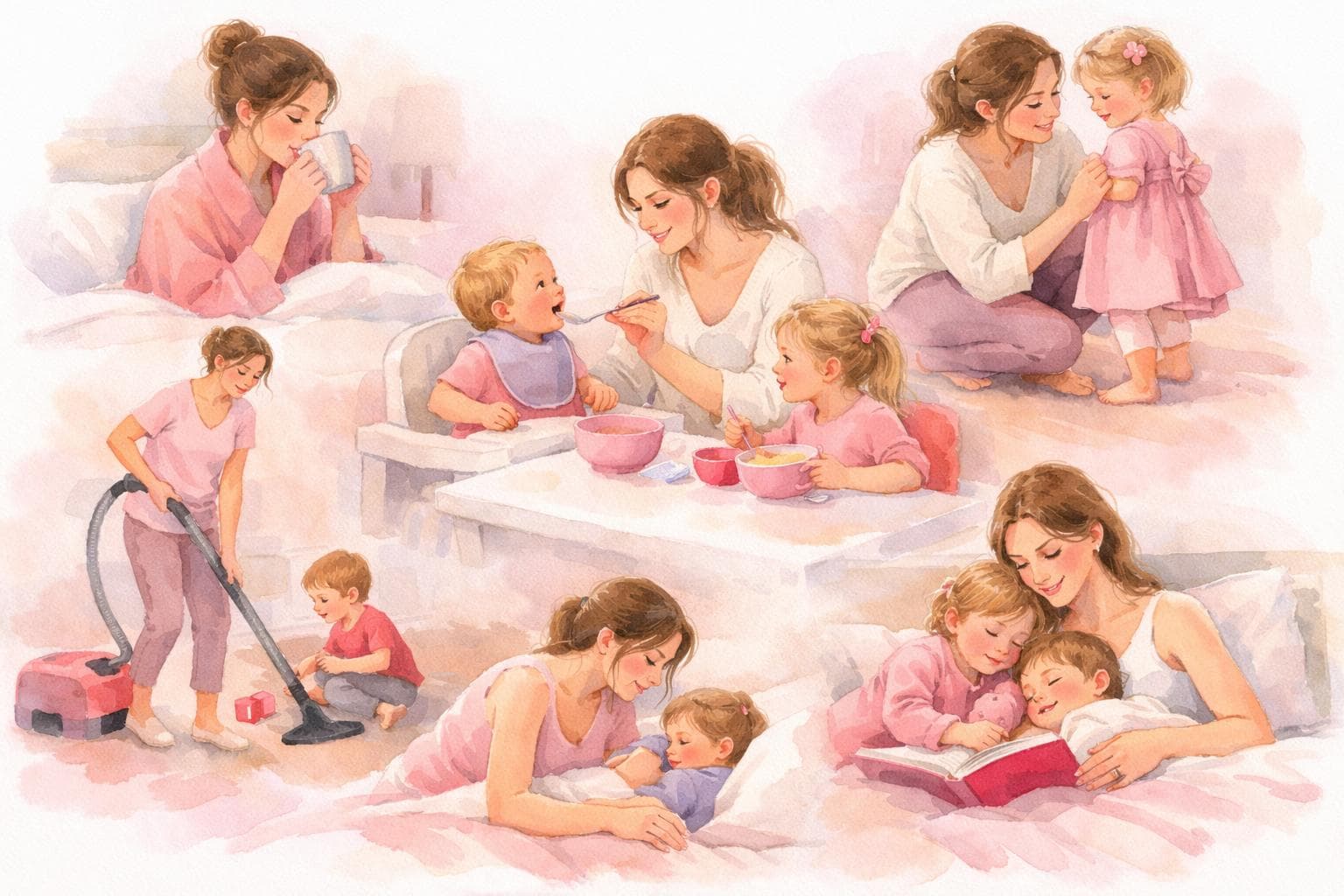
The version of this day on your For You page has soft lighting, a matching linen set and a toddler who eats blueberries without smearing them into the couch. Somewhere around minute two, a coffee gets poured and stays hot long enough to drink. That video is not lying exactly. It is just showing you one frame out of a thousand, and the other 999 look nothing like it.
Here is what the day actually looks like, hour by hour, and why the gap between the two versions matters more than it seems.
A real stay-at-home mom's day is a continuous stretch of overlapping physical care, cognitive tracking and emotional labour from roughly 5:30am until a child's bedtime, frequently followed by household or planning tasks afterward, distinct from its social media portrayal by the absence of edited pauses, matching outfits and a single, uninterrupted narrative thread. Research cited by Motherly found that stay-at-home mothers report higher stress levels than working mothers on several measures, a finding that runs directly against the cultural assumption that staying home is the easier, lower-pressure path. Lightfully's 2026 clinical review of stay-at-home motherhood names this gap directly: the outdated image of an effortless, restful day at home persists in some corners of culture, even though the actual experience is a relentless, never-ending physical, emotional and mental undertaking. This is the version without the filter.
5:30 to 7:00am: before anyone else is awake
The day usually starts before the household does, not because of some productivity hack, but because a small window of quiet is the only genuinely uninterrupted time available. Coffee, maybe. A few minutes of actual silence, if a child does not wake early. This window is frequently interrupted anyway, and when it is, the day simply starts an hour earlier than planned.
7:00 to 9:00am: the morning is not one task, it is forty
Breakfast, dressing, brushing teeth, finding the missing shoe, managing a meltdown about the wrong colour cup, all while tracking whether today is a library day, whether the diaper bag is stocked, and whether anyone needs to be somewhere by a specific time. Thoughtful Parent's 2025 research on stay-at-home routines notes that in the early months especially, there is no real schedule to follow, since infants do not organise themselves around a clock the way older children eventually do. The morning is less a routine and more a continuous sequence of small decisions.
9:00am to 12:00pm: the flexible block that isn't
This is the stretch a curated video usually shows as a craft project or a park visit, shot in good light. In reality, it is errands, a paediatrician call, laundry started and abandoned twice, and the background hum of tracking what the family will need later today, tomorrow, next week. Lightfully's clinical review names this specifically as the mental load, the invisible work of noticing and planning what everyone needs, running constantly underneath whatever visible activity is happening on the surface.
12:00 to 2:00pm: the nap window that is not actually rest
If a nap happens, this is often the only stretch resembling a break, and it is frequently consumed by tasks that require quiet rather than genuine rest: dishes, a phone call, meal prep for later. A 2025 study cited by Motherly found that many stay-at-home mothers describe this exact window as more draining than restorative, since it becomes another task-completion period rather than downtime.
2:00 to 5:00pm: the long afternoon stretch
Energy typically dips here for both mother and child, and this is often where irritability, boredom and the sharpest edges of the day show up. Lightfully's research names loneliness as one of the most disorienting parts of this period specifically: spending all day with children does not reliably meet the need for adult connection or intellectual stimulation, meaning a mother can be constantly surrounded by people and still feel profoundly isolated.
5:00 to 7:30pm: the second shift begins
Dinner, bath, the transition toward bedtime, often the most physically demanding block of the day layered directly on top of whatever energy remains from everything before it. This period frequently overlaps with a partner's return home, which introduces its own coordination, handing off information about the day, managing the transition, sometimes managing disappointment that the house is not further along than it is.
7:30 to 9:00pm: bedtime is a project, not an event
Books, water requests, one more hug, the negotiation that extends bedtime by twenty minutes despite every routine designed to prevent it. Once a child is actually asleep, the day frequently is not over. Household tasks, tomorrow's planning, and any personal task that required quiet all compete for whatever hour remains before exhaustion wins.
What social media shows vs what the day actually includes
Social media SAHM content | The actual day | |
|---|---|---|
Visual framing | Curated lighting, one activity per clip, matching outfits | Overlapping, simultaneous tasks with no visual edit |
Emotional tone shown | Calm, joyful, aesthetically pleasing | A wide range including boredom, irritation, tenderness and exhaustion, often within the same hour |
Mental load | Rarely shown; the day appears to run itself | Constant, running underneath every visible activity |
Adult connection | Not addressed | Frequently the missing ingredient, even surrounded by children all day |
Rest periods | Implied through soft pacing and music | Often consumed by tasks requiring quiet, not genuine rest |
Comparison effect | Sets an unspoken standard other mothers measure themselves against | Contributes directly to feelings of inadequacy, according to research on SAHM stress |
Why the gap between the two versions matters
Your Ideal Mom Life's research on SAHM stress found that social media functions as a specific, documented stress factor, since images of seemingly perfect mothers create a comparison standard that failure to meet often produces feelings of inadequacy, even among mothers doing everything reasonably well. This is not a minor cultural quirk. It is a measurable contributor to the same burnout and depression patterns covered in our guide to mom burnout: signs you shouldn't ignore.
"This lack of boundaries can contribute to mental and emotional fatigue over time. Supporting your children's emotions is an important part of parenting, but it can also be draining." - Lightfully (2026)
What actually helps, according to the research
Phoenix Health's 2026 clinical review identifies one specific, protective intervention with the strongest evidence: maintaining at least one non-negotiable personal activity each week that belongs entirely to you, outside caregiving. Vanderbilt University's research found this works not primarily through income, but through the external role itself, having something that reflects your own competence and identity back to you.
If loneliness, specifically, is the part of this day that weighs heaviest, our guide to how to make adult friends after having kids addresses that directly. And if the invisible tracking underneath every hour of this day is what feels unsustainable, our time audit of that exact work puts a number on what social media never shows.
Key takeaways
- Research consistently finds stay-at-home mothers report higher stress on several measures than working mothers, directly contradicting the cultural assumption that staying home is the easier path.
- The mental load runs continuously underneath the entire day, not as a separate task but as a constant background process of noticing, planning and anticipating what the family will need.
- Loneliness is one of the most disorienting parts of this day specifically, since spending all day surrounded by children does not reliably meet the need for adult connection.
- Social media comparison functions as a documented, measurable stress factor, with curated content setting an unspoken standard that contributes directly to feelings of inadequacy.
- One protected, non-negotiable personal activity each week is the single most evidence-backed intervention for the identity erosion and isolation this day can produce.
Sources and further reading
- Lightfully. (2026). Stay-at-home motherhood: 8 emotional realities no one talks about. lightfully.com
- Motherly. (2025). Study explores why being a stay-at-home mom feels harder than work. mother.ly
- Phoenix Health. (2026). Stay-at-home mom depression: what the research shows. joinphoenixhealth.com
- Thoughtful Parent. (2025). Stay-at-home mom routine: a realistic plan for a smooth day. thoughtfulparent.com
- Your Ideal Mom Life. (2025). Why are stay-at-home moms so stressed? youridealmomlife.com
- Vanderbilt University. Research on maternal employment and mental health, cited in Phoenix Health (2026).