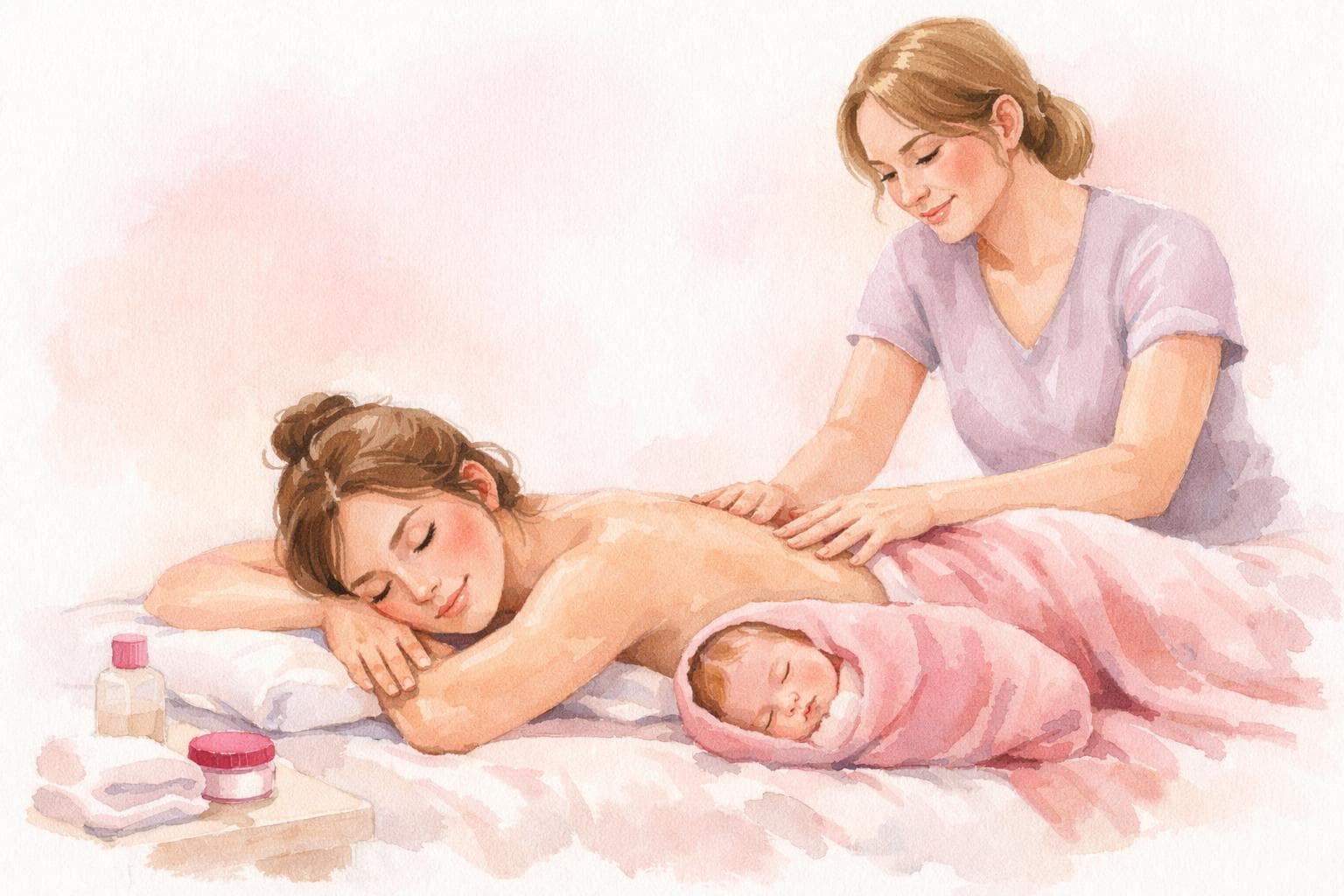
Nobody touched you gently in weeks. Every touch since the birth has been functional: the baby latching, the midwife checking your stitches, a toddler climbing onto your lap. Your body has been needed constantly but cared for almost never.
Then someone suggests a massage. And your first thought is not "that sounds lovely." It is "am I even allowed?"
You are. And the research says it might do more for your recovery than you expect.
Is postpartum massage safe?
For most women, massage is safe within the first few weeks after a vaginal delivery, provided there are no complications. After a caesarean section, most practitioners recommend waiting until the incision has healed, typically around six weeks, before receiving abdominal work. Back, shoulder, leg and foot massage can usually begin sooner.
The American Pregnancy Association lists postpartum massage as a safe and beneficial practice that supports hormonal balance, fluid regulation and emotional recovery. However, certain conditions require medical clearance first:
- Pre-eclampsia or high blood pressure that has not resolved
- Deep vein thrombosis (DVT) or risk factors for blood clots
- Open wounds or unhealed surgical sites
- Infections or fever
If you are unsure, ask your midwife or GP before booking. A qualified postnatal massage therapist will also ask about your birth history and any complications before beginning.
What the research says about massage and postpartum depression
The evidence is still growing, but what exists is promising.
A study by Field and colleagues compared 10 sessions of massage therapy against 10 sessions of relaxation therapy in 32 postpartum mothers with depression. Both groups showed lower anxiety scores after individual sessions, but only the massage group showed statistically significant decreases in depression scores, state anxiety and salivary cortisol levels over the full course of treatment.
A randomised controlled trial published in Annals of Clinical and Analytical Medicine (2025) tested classical massage applied during the early postpartum period and found significant reductions in Edinburgh Postnatal Depression Scale (EPDS) scores in the massage group compared to controls. The same study found improved functional recovery scores, suggesting that massage supports both psychological and physical healing after birth.
Separate research found that women who received massage during pregnancy had lower postpartum depression scores, lower cortisol levels and infants with higher scores on the Brazelton Neonatal Behavioral Assessment Scale. The benefits appeared to carry over from pregnancy into the postnatal period.
"Massage is a safe, accessible, and non-pharmacological intervention that can support psychological well-being in postpartum women. Short-term massage sessions may enhance emotional resilience and sleep quality." - Annals of Clinical and Analytical Medicine (2025)
How massage helps your postpartum body
The physical benefits go beyond relaxation. Here is what massage targets during the postnatal period:
What massage helps | How it works |
|---|---|
Cortisol regulation | Massage reduces circulating cortisol, the primary stress hormone, which is often elevated in postpartum women |
Hormone balance | Oestrogen and progesterone drop sharply after birth; massage supports the nervous system through this transition |
Fluid retention | Postpartum bodies carry up to 50% more fluid volume; massage improves lymphatic drainage and circulation |
Muscle tension | Carrying, feeding and hunching over a baby create chronic tension in the neck, shoulders and lower back |
Sleep quality | By activating the parasympathetic nervous system, massage can improve both sleep onset and sleep depth |
Pain management | C-section scar tissue, perineal soreness and joint stiffness all respond to targeted soft-tissue work |
For mothers who are also dealing with the emotional exhaustion of early motherhood, the nervous system reset that massage provides can feel like the first full breath you have taken in months.
Types of postpartum massage
Not all massage is the same. Here are the most common types offered to postnatal women:
- Swedish massage. Gentle, flowing strokes that promote relaxation and circulation. The most common choice for early postpartum recovery.
- Deep tissue massage. Firmer pressure targeting chronic muscle tension. Best once initial healing is complete, usually after six weeks.
- Lymphatic drainage massage. Light, rhythmic movements that reduce swelling. Particularly helpful for women with significant fluid retention or post-caesarean oedema.
- Myofascial release. Targets the connective tissue (fascia) around muscles. Useful for C-section scar tissue and pelvic floor tension.
- Aromatherapy massage. Combines gentle massage with essential oils. Lavender and chamomile are commonly used for relaxation, though some oils should be avoided during breastfeeding. Always check with your therapist.
Massage as a complement, not a replacement
Massage can reduce symptoms of postpartum depression and anxiety. But it is not a standalone treatment for moderate to severe PPD. It works best as one part of a wider recovery plan.
If you are experiencing persistent low mood, intrusive thoughts or difficulty functioning, massage may support you alongside therapy or medication, not instead of them. For more on those options, see our guides to CBT for postpartum depression and PPD medication.
Think of massage as the layer that cares for your body while therapy cares for your mind. Both matter. Neither cancels the other out.
What to look for in a postnatal massage therapist
The quality of your experience depends heavily on who you choose. Here is what to ask:
- Are you trained in postnatal massage? General massage training does not cover the specific needs of postpartum bodies. Look for additional qualifications in pre and postnatal work.
- Do you ask about birth history? A good therapist will want to know how you delivered, whether there were complications and how far postpartum you are before they begin.
- Can you accommodate breastfeeding? Some therapists offer positioning adjustments (side-lying instead of face-down) for women with engorged breasts or who need to feed during the session.
- Do you offer home visits? Leaving the house with a newborn can feel impossible. Many postnatal massage therapists will come to you, which removes one of the biggest barriers to actually booking.
Partner massage as a low-cost alternative
If professional massage is not affordable or accessible, partner-delivered massage has its own evidence base. Research by Field and colleagues found that massage provided by a woman's partner over 12 weeks during pregnancy led to lower depression scores and lower cortisol in both the mother and newborn.
A 2025 study on post-caesarean mothers found that even short back massage sessions (10 minutes, four times a day) significantly reduced depression, anxiety and stress scores.
You do not need a professional to benefit. A partner who is willing to learn basic techniques, apply gentle pressure to the shoulders and lower back and offer 15 minutes of focused, caring touch can make a meaningful difference. It also strengthens the bond between you at a time when connection can feel strained.
If your relationship is feeling the pressure of new parenthood, you might also find it helpful to read about sex after baby and the physical reconnection that often needs rebuilding alongside emotional closeness.
You deserve to be touched with care
Motherhood asks your body to give constantly. Massage is one of the few things that gives something back. It is not a luxury or an indulgence. It is a legitimate, evidence-backed intervention that supports your physical recovery, your hormonal balance and your mental health.
Book one session. See how it feels. You might be surprised by what it unlocks.
Sources and further reading
- Field, T. et al. (1996). Massage therapy effects on depressed adolescent mothers. Adolescence, 31(124), 903-911.
- Field, T. (2010). Postpartum depression effects on early interactions, parenting, and safety practices: a review. Infant Behavior and Development. sciencedirect.com
- Annals of Clinical and Analytical Medicine. (2025). The role of massage therapy in postpartum depression and functional recovery: a randomised controlled trial. acamedicine.org
- PMC (2025). Impact of affirmation relaxation and back massage on depression, anxiety, and stress in mothers who have undergone caesarean section. pmc.ncbi.nlm.nih.gov
- American Pregnancy Association. Postpartum massage. americanpregnancy.org
- MGH Center for Women's Mental Health. Massage therapy for depression. womensmentalhealth.org