
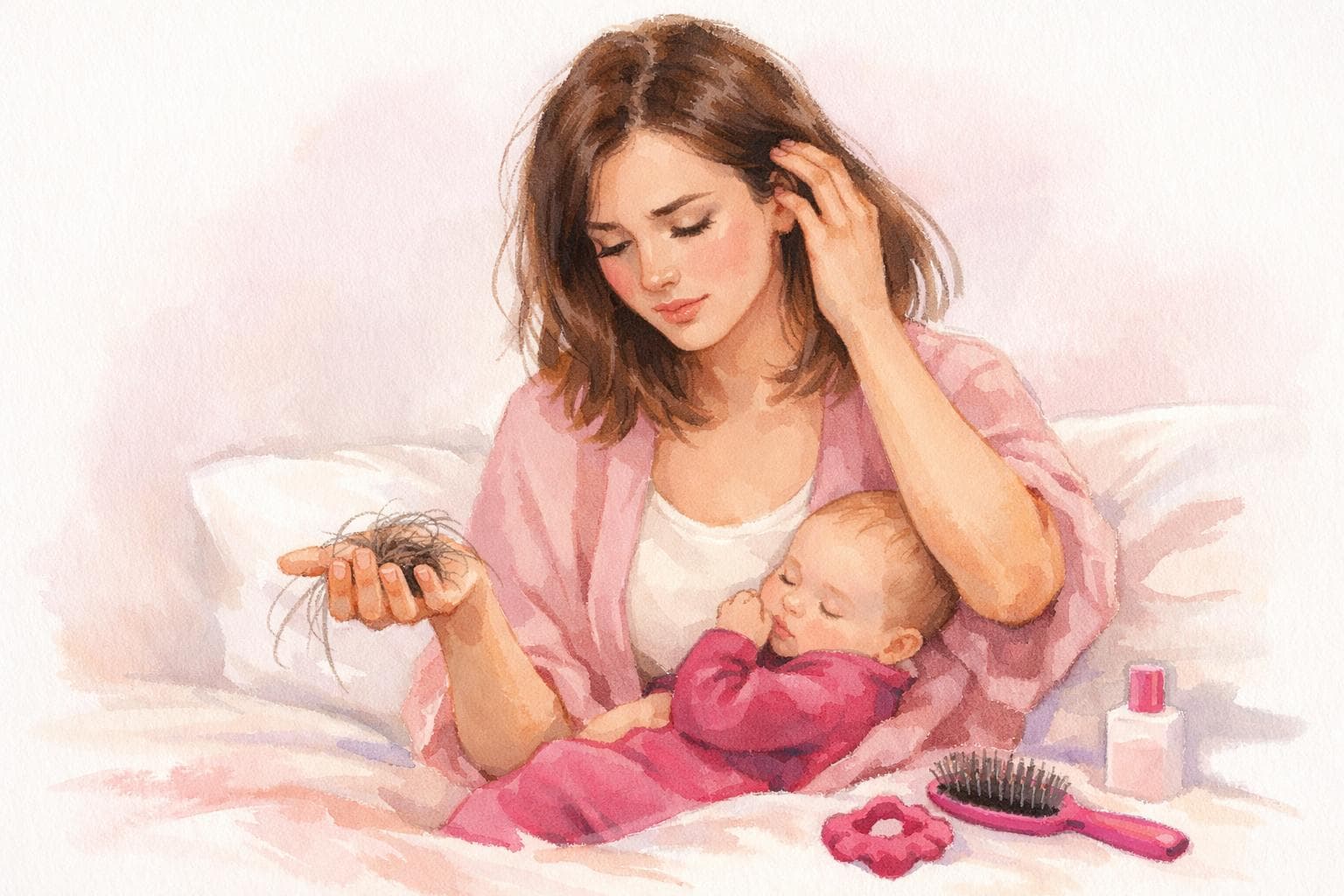
You counted the weeks with your due date the same obsessive way, and now you are counting again, except this time it is fistfuls of hair in the shower drain. Everyone tells you it is temporary. Nobody tells you exactly when temporary actually ends, and that gap between "it will pass" and "when, specifically" is where most of the panic lives.
The postpartum hair loss timeline describes the predictable but individually variable sequence of hormonal hair shedding after childbirth, medically called postpartum telogen effluvium, which typically begins 2 to 4 months after delivery, peaks around month four, and resolves within 6 to 12 months as the hair cycle resets to its pre-pregnancy pattern. During pregnancy, elevated progesterone increases hair shaft diameter and inhibits androgen secretion, keeping a larger share of follicles in the active growth phase for longer than usual. After delivery, progesterone drops sharply while prolactin rises, triggering a premature, synchronized shift of those follicles into the shedding phase, according to a 2024 clinical study published in the Journal of Clinical and Aesthetic Dermatology. This guide breaks down exactly where that timeline comes from, why it shifts from person to person, and what actually marks the end of it.
The full timeline, stage by stage
Stage | Typical timing | What is happening physiologically |
|---|---|---|
Pregnancy | Weeks 1 to birth | Elevated progesterone extends the anagen, or growth, phase; hair often looks thicker and fuller |
Immediate postpartum | Weeks 1 to 6 | Progesterone drops sharply, prolactin rises; little visible shedding yet |
Early shedding | 2 to 4 months postpartum | Follicles synchronously shift into telogen, the resting phase; shedding becomes noticeable |
Peak shedding | Around month 4 | The largest visible hair loss; daily shedding can climb well above the usual 50 to 100 strands |
Gradual recovery | 6 to 12 months | Hair cycling desynchronizes and returns to its normal, staggered pattern |
Full resolution | By baby's first birthday, typically | Most women regain pre-pregnancy fullness, though texture can shift slightly |
Why the timeline is not identical for every mother
A 2024 study on 200 women, all clinically diagnosed with postpartum telogen effluvium, specifically evaluated a set of factors researchers consider relevant to how the condition presents: age, number of pregnancies, socioeconomic status, delivery type, whether the mother was breastfeeding, and any post-labor complications. The women in that study ranged from 20 to 38 years old, with a median of two pregnancies each, and clinical severity was graded using a standardised scale rather than guesswork.
Factor | How it shifts the timeline |
|---|---|
Breastfeeding | Prolonged hormonal fluctuation can extend the shedding window compared to non-breastfeeding mothers |
Number of pregnancies | Repeated pregnancies are associated with cumulative changes in follicle behaviour over time |
Delivery type | Both Caesarean and vaginal delivery are tracked as relevant variables in clinical evaluation, though shedding is not exclusive to either |
Underlying conditions | A history of PCOS, thyroid irregularities or hirsutism can complicate or extend recovery |
Post-labor complications | Additional physical stress on the body can influence the severity of the hormonal shift |
Our guide to postpartum hair loss treatments ranked by effectiveness covers what actually helps once you know where you sit on this timeline, and our roundup of postpartum hair loss lotions you can try without a prescription covers the gentlest starting options.
An honest caveat most articles skip
This deserves real transparency. A review published in the dermatology journal Medigraphic makes a point worth sitting with: despite postpartum shedding being mentioned constantly in classic dermatological literature, there have only ever been two dedicated clinical studies specifically measuring postpartum telogen effluvium, one in 1960 and one in 2013, and no study has definitively demonstrated the precise causal mechanism. The researchers explicitly call for further trials using objective measurement methods to better understand the condition and develop more tailored treatment.
This does not mean the postpartum hormone drop is not real, or that your shedding is not genuinely happening for the reasons doctors describe. It means the specific numbers thrown around, like exactly what percentage of follicles shift phase, rest on a thinner research base than the confident tone of most hair-care marketing suggests.
"Hair loss in the months after delivery is a frequent cause of dermatological consultation due to anxiety." - Medigraphic, dermatology review
What objective measurement actually found
Not all the research is this limited, though. A trichoscopic study tracked 116 women across four distinct stages, 28 at 24 weeks pregnant, 30 at full-term pregnancy, 29 at four months postpartum, and 29 at one year postpartum, using a device called a Trichoscan to objectively measure the ratio of anagen to telogen hairs at each stage rather than relying on self-reported shedding. The study also recorded which participants were breastfeeding and at what month they were examined, allowing researchers to compare hair cycling directly against hormonal and lactation status rather than guessing.
When the timeline itself is the warning sign
Most of the time, this timeline resolves on its own schedule without any intervention. But the timeline itself becomes a useful diagnostic tool the moment it breaks its own pattern:
- Shedding that has not slowed by month 6 of the postpartum period, when peak shedding should already be tapering
- No visible improvement by 12 months, the outer edge of the typical resolution window
- Shedding that restarts after appearing to resolve, rather than following the expected single-peak curve
- Patchy rather than diffuse loss, which does not fit the synchronized-shedding pattern this timeline describes at all
A dermatologist can use a simple hair pull test, the same method used in the 200-patient study above, grasping roughly 60 hairs and gently pulling from root to tip, to compare your actual shedding pattern against what the expected timeline predicts.
Key takeaways
- Postpartum shedding typically begins 2 to 4 months after delivery, peaks around month four, and resolves within 6 to 12 months, driven by a sharp drop in progesterone paired with a rise in prolactin.
- Breastfeeding status, number of pregnancies, delivery type and underlying hormonal conditions all shift the individual timeline, according to factors tracked in a 2024 clinical study of 200 women.
- Only two dedicated clinical studies have ever specifically measured postpartum telogen effluvium, in 1960 and 2013, meaning some commonly cited statistics rest on a thinner evidence base than marketing tone suggests.
- Objective trichoscopic measurement across 116 women confirmed real, measurable shifts in hair cycling from pregnancy through the first postpartum year, tracked against lactation status.
- A timeline that breaks its own pattern, no improvement by 12 months, restarting shedding, or patchy rather than diffuse loss, is the clearest signal to see a dermatologist, rather than continuing to wait it out.
Sources and further reading
- Journal of Clinical and Aesthetic Dermatology. (2024). Postpartum Telogen Effluvium Unmasking Additional Latent Hair Loss Disorders. jcadonline.com
- Medigraphic. (2022). Postpartum and lactation: a true cause of telogen effluvium? medigraphic.com
- Rebora, A. (2019). Telogen effluvium: a comprehensive review. Clinical, Cosmetic and Investigational Dermatology, 12, 583-590.
- Westgate, G.E., Grohmann, D. & Sáez Moya, M. (2025). Hair Longevity: Evidence for a Multifactorial Holistic Approach to Managing Hair Aging Changes. Journal of Clinical Medicine, 14(6), 1894.
- Johns Hopkins Medicine. (2025). Postpartum hair loss. hopkinsmedicine.org
- GoodRx. (2026). Postpartum hair loss: causes, diagnosis, and treatment. goodrx.com