You want to move again. Not to punish your body, not to chase some pre-baby version of yourself, just to feel like your muscles remember what they are for. But the search for a postpartum class turns up either intimidating studio programs that assume you already know what diastasis recti is, or vague YouTube videos with no idea whether they are actually safe for where you are in recovery.
Here is what the research actually supports, and how the real programs compare.
A postpartum exercise class is structured physical activity specifically designed for the recovery needs of the postnatal body, addressing pelvic floor function, abdominal separation and a graduated return to activity, distinct from general fitness classes that do not account for postpartum-specific physiology. According to a 2025 review published in the Delaware Journal of Public Health, postpartum participation requires particular attention to pelvic floor function, tissue healing and a structured return-to-activity progression, and collaboration between clinicians and qualified exercise professionals both improves safety and expands access to appropriate programming. The American College of Obstetricians and Gynecologists recommends 20 to 30 minutes of exercise per day to support postpartum recovery, noting that this kind of gentle movement can reduce stress, boost energy and even lower the risk of postpartum depression. This guide compares the real options, in-person and online, against that evidence base.
When to actually start, according to ACOG
Physiopedia's summary of current ACOG guidance is clear: timing depends on delivery type and individual recovery, not a single fixed date for everyone.
Delivery type | Recommended waiting period | What to focus on first |
|---|---|---|
Uncomplicated vaginal birth | Short walks within days are generally fine; structured classes typically wait until the 6-week checkup | Breathing, gentle mobility, pelvic floor awareness |
Complicated vaginal birth, tearing, assisted delivery | Often longer, guided by your provider's assessment at follow-up | Individualised clearance before structured programming |
Caesarean section | 8 to 12 weeks before core-heavy work, given this is major abdominal surgery | Incision healing, breathing, gentle mobility rather than intensity |
The consistent thread across sources is that the six-week checkup is the standard gate for starting structured programming, not a suggestion to wait passively before then. Our postpartum recovery timeline guide covers the fuller picture of what is happening in your body across this window.
In-person vs online classes: what the comparison actually shows
In-person classes | Online programs | |
|---|---|---|
Real-time form correction | Yes, immediate | Limited to video review or occasional live check-ins |
Childcare logistics | Requires arranging care or a baby-inclusive class format | None required; can be done around nap times |
Community element | Built in; other postpartum mothers in the room | Requires deliberate effort through forums or group chats, if offered |
Cost | Often higher, studio membership or per-class fees | Generally lower, subscription-based |
Evidence base | Strong for pelvic floor muscle training generally | A 2024 quasi-experimental study specifically tested a 6-week online programme with measurable results |
Flexibility | Fixed schedule | Pause-and-resume flexibility, useful with an unpredictable newborn |
Best for | Mothers who want hands-on correction and in-person accountability | Mothers with limited childcare access, tight schedules or geographic distance from specialised providers |
What the research says about online programmes specifically
This is worth taking seriously, because online postpartum fitness is sometimes dismissed as lower quality by default. A quasi-experimental study conducted at the University of Turku evaluated a 6-week online exercise programme called Rehabilitate Your Core, developed by Nordic Fit Mama, assessing quality of life, physical activity levels and pelvic floor dysfunction symptoms, including urinary incontinence and pelvic organ prolapse, both immediately after the programme and six months later. The study found measurable improvements across these outcomes using self-assessed questionnaires collected before and after the intervention.
A separate randomised controlled trial protocol, the PEFLOW study, was specifically designed to compare postpartum women performing a whole-body pelvic floor workout at home under professional online guidance against a control group, reflecting a broader research trend toward validating remote, professionally guided programming rather than treating it as inherently inferior to in-person instruction.
"Collaboration between clinicians and qualified exercise professionals enhances safety, increases adherence, and expands access to safe programming." - Delaware Journal of Public Health (2025)
What a quality programme actually includes, regardless of format
Whether you choose in-person or online, the research points to specific elements that distinguish a properly designed postpartum programme from a generic fitness class relabelled for new mothers.
- Pelvic floor assessment or guidance before core-heavy work. A 2026 study on biomechanics-based core training in postpartum stress urinary incontinence found that combining core training with standard pelvic floor muscle training produced significantly better outcomes than pelvic floor training alone, measured through validated tools like the 1-hour pad test and the ICIQ-UI Short Form.
- A graduated return-to-activity structure, not an assumption that you can resume pre-pregnancy intensity immediately.
- Explicit attention to diastasis recti, abdominal separation, rather than generic core work that can worsen the condition if approached incorrectly.
- Modification options for C-section recovery, since a program built only around vaginal delivery timelines will not serve every mother appropriately.
For a deeper look at diastasis recti specifically and what actually helps it heal, our guide comparing abdominal exercises and belly binding covers the evidence on both approaches.
Realistic options by category
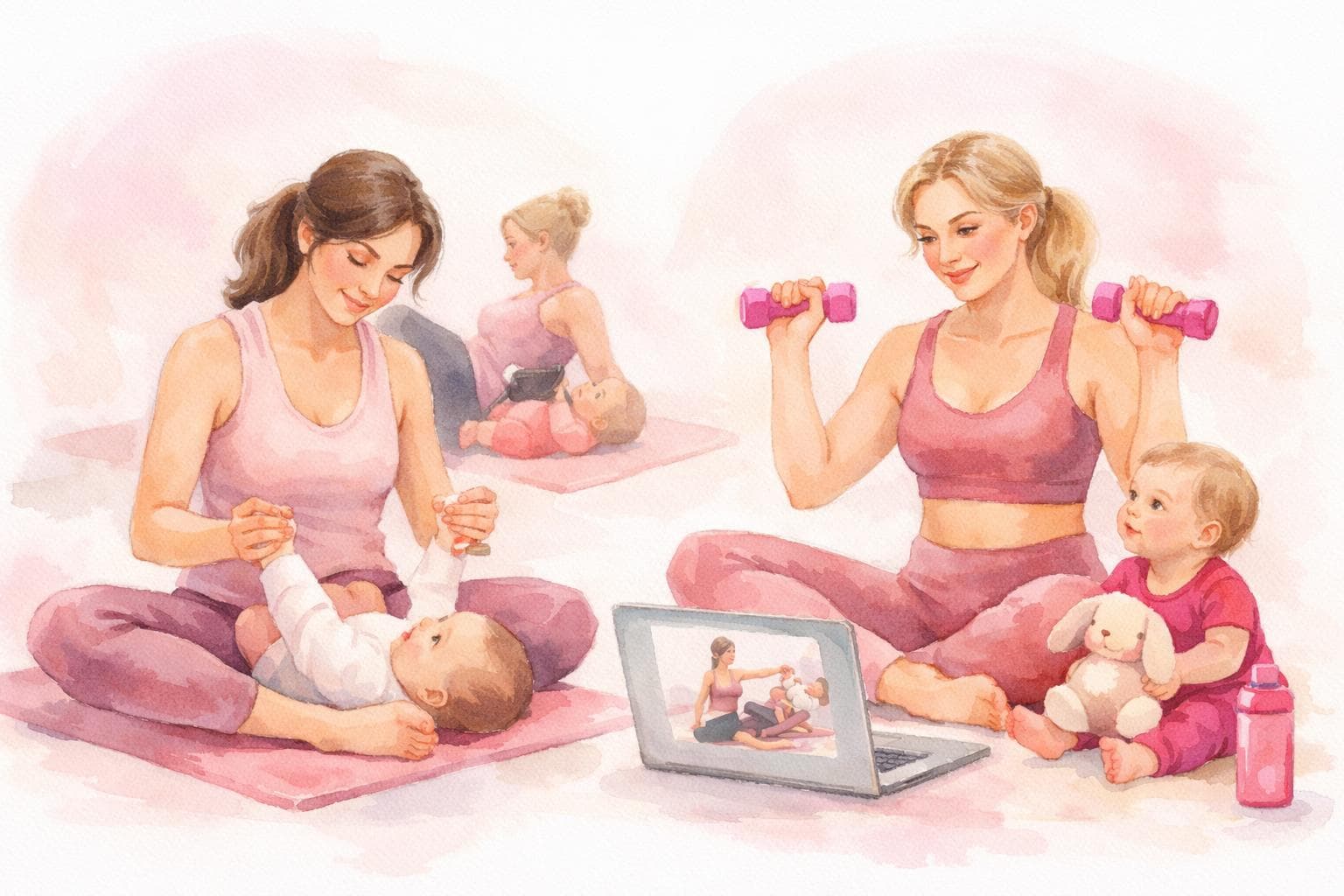
Baby-inclusive in-person classes. Studios and community centres offering mommy-and-me or stroller-fitness formats remove the childcare barrier directly, letting you bring your baby into the session itself.
Specialist pelvic floor physiotherapy-led classes. Often the gold standard for complex presentations, incontinence, prolapse symptoms or significant diastasis recti, since these are led by licensed physiotherapists rather than general fitness instructors.
Structured online subscription programmes. Platforms modelled on the Rehabilitate Your Core format, offering a defined multi-week curriculum rather than a random collection of videos, appear to produce more consistent results than unstructured content.
Free or low-cost app-based routines. A reasonable starting point for gentle movement in the earliest weeks, though these typically lack the individualised pelvic floor assessment that more structured programmes include.
If cost is a significant barrier to structured programming, our guide to financial help for single moms covers broader assistance options, some of which may extend to postpartum health services depending on your location and insurance coverage.
Key takeaways
- ACOG recommends 20 to 30 minutes of daily exercise to support postpartum recovery, linking gentle movement to reduced stress, increased energy and lower postpartum depression risk.
- The six-week checkup is the standard gate for structured programming, with C-section recovery typically requiring 8 to 12 weeks before core-heavy work begins.
- Online postpartum exercise programmes have measurable research support. A University of Turku study found improvements in quality of life and pelvic floor symptoms following a 6-week online programme, both immediately and at 6-month follow-up.
- Combining core training with standard pelvic floor muscle training outperforms pelvic floor training alone, according to 2026 research on postpartum stress urinary incontinence.
- The best format depends on your specific needs. Complex pelvic floor symptoms warrant specialist-led, often in-person care, while general postpartum fitness with childcare or scheduling constraints is well supported by structured online programming.
Sources and further reading
- Olsen, J. et al. (2025). Rethinking prenatal and postpartum exercise. Delaware Journal of Public Health, 11(5), 32-36. pmc.ncbi.nlm.nih.gov
- University of Turku. (2023). The effectiveness of an online exercise program on well-being of postpartum women. ClinicalTrials.gov NCT06268782.
- Yang, X. et al. (2026). Efficacy of biomechanics-based core muscle training in patients with postpartum stress urinary incontinence. Medicine, 105(7). ncbi.nlm.nih.gov
- American College of Obstetricians and Gynecologists. (2026). Exercises after pregnancy: 5 exercises you can do at home. acog.org
- Physiopedia. (2025). Current guidelines and recommendations for postnatal exercise. physio-pedia.com
- ModernMom. (2026). Top post pregnancy fitness classes 2026. modernmom.com