Everyone worries when they have a new baby.
You worry about whether they're breathing. You worry about whether they're eating enough, sleeping enough, gaining enough weight. You check on them at night more than you need to and you know you're doing it and you do it anyway. This is ordinary. This is love meeting vulnerability for the first time at close range.
But there is a point at which worry stops being the normal background noise of new parenthood and starts being something that is running the show. Something that interrupts your sleep even when the baby is sleeping. Something that follows you into rooms and doesn't leave when the immediate concern has passed. Something that has started making your world smaller.
Knowing the difference between ordinary new-parent worry and postpartum anxiety is not always easy from the inside. But it matters, because postpartum anxiety is one of the most common and most undertreated conditions in the perinatal period, and the fact that it often looks like good parenting is part of why it goes unrecognised for so long.
How common is postpartum anxiety?
More common than most people know, and more common than postpartum depression in some estimates.
A 2013 study published in the Journal of Affective Disorders found that up to 20% of new mothers experience clinically significant anxiety in the postpartum period. A more recent 2021 meta-analysis in BMC Pregnancy and Childbirth put the figure at 18%, though researchers noted significant variation across countries and populations. Critically, the same research found that postpartum anxiety is screened for far less consistently than postpartum depression, which means many women experiencing it are neither identified nor offered support.
In the UK, the NHS acknowledges postpartum anxiety as a significant perinatal mental health condition but notes that many women do not seek help, often because they believe their worry is simply what responsible parenting looks like, or because they fear being judged.
Postpartum anxiety symptoms: when worry goes too far
The distinction that matters is not whether you are worried but how the worry is functioning in your daily life.
Signs that what you are experiencing may be postpartum anxiety rather than ordinary new-parent concern:
- Worry that feels constant rather than situational, present even when nothing specific has triggered it
- Physical symptoms including a racing heart, tightness in the chest, nausea or difficulty breathing that arrive alongside or independently of anxious thoughts
- Difficulty sleeping even when the baby is asleep and you are exhausted
- Racing thoughts that you cannot slow down, particularly at night
- Avoiding situations or places because of what might happen, even when the risk is low
- Checking behaviours that have grown beyond what is practical, checking breathing repeatedly, researching symptoms obsessively, seeking reassurance that doesn't stay reassuring
- A sense of impending doom or the persistent feeling that something terrible is about to happen
- Irritability or anger that feels disproportionate to what triggered it
The last two are worth highlighting because they are frequently unrecognised as anxiety symptoms. Postpartum anxiety does not always look like fear. It often looks like hypervigilance, restlessness and a low threshold for frustration. Many mothers experiencing it describe feeling wired rather than worried, as though their nervous system is permanently running at a higher frequency than it should be.
Postpartum anxiety vs. postpartum depression: what's the difference?
The two conditions frequently co-occur and can be difficult to distinguish, partly because they share some symptoms and partly because neither always looks the way people expect.
Postpartum anxiety / Postpartum depression
Primary experience is fear, worry and hypervigilance / Primary experience is sadness, numbness or emptiness
May feel wired, restless or unable to switch off / May feel slowed down, flat or without motivation
Sleep disruption driven by inability to stop thinking /Sleep disruption driven by low energy and disengagement
Often feels like caring too much / Often feels like caring too little
Racing thoughts are common / Intrusive thoughts of hopelessness are common
May maintain functioning but at high internal cost / Functioning is often more visibly impaired
It is worth knowing that having one does not exclude the other. Research consistently finds that around 50% of women with postpartum depression also experience significant anxiety. If you recognise features of both, that is not unusual and does not complicate treatment: it simply means the full picture needs to be presented to a professional who can work with both.
What causes postpartum anxiety?
Understanding the contributing factors does not make the experience less real but it does make it less mysterious, which tends to help.
Hormonal changes following birth, particularly the rapid drop in oestrogen and progesterone, directly affect the neurotransmitter systems involved in anxiety regulation. Sleep deprivation significantly reduces the brain's capacity to regulate threat response. The amygdala, the part of the brain that processes danger, becomes more reactive on less sleep, which is why chronically sleep-deprived new mothers are neurologically primed for heightened anxiety.
There is also a psychological dimension. For many women, becoming a mother activates early attachment patterns and unresolved fears in ways that were not present or not as loud before. A history of anxiety, trauma or significant loss can amplify the postpartum anxiety response. But postpartum anxiety also develops in women with no previous history of mental health difficulties, which means it should not be written off as simply a continuation of an existing pattern.
What actually helps
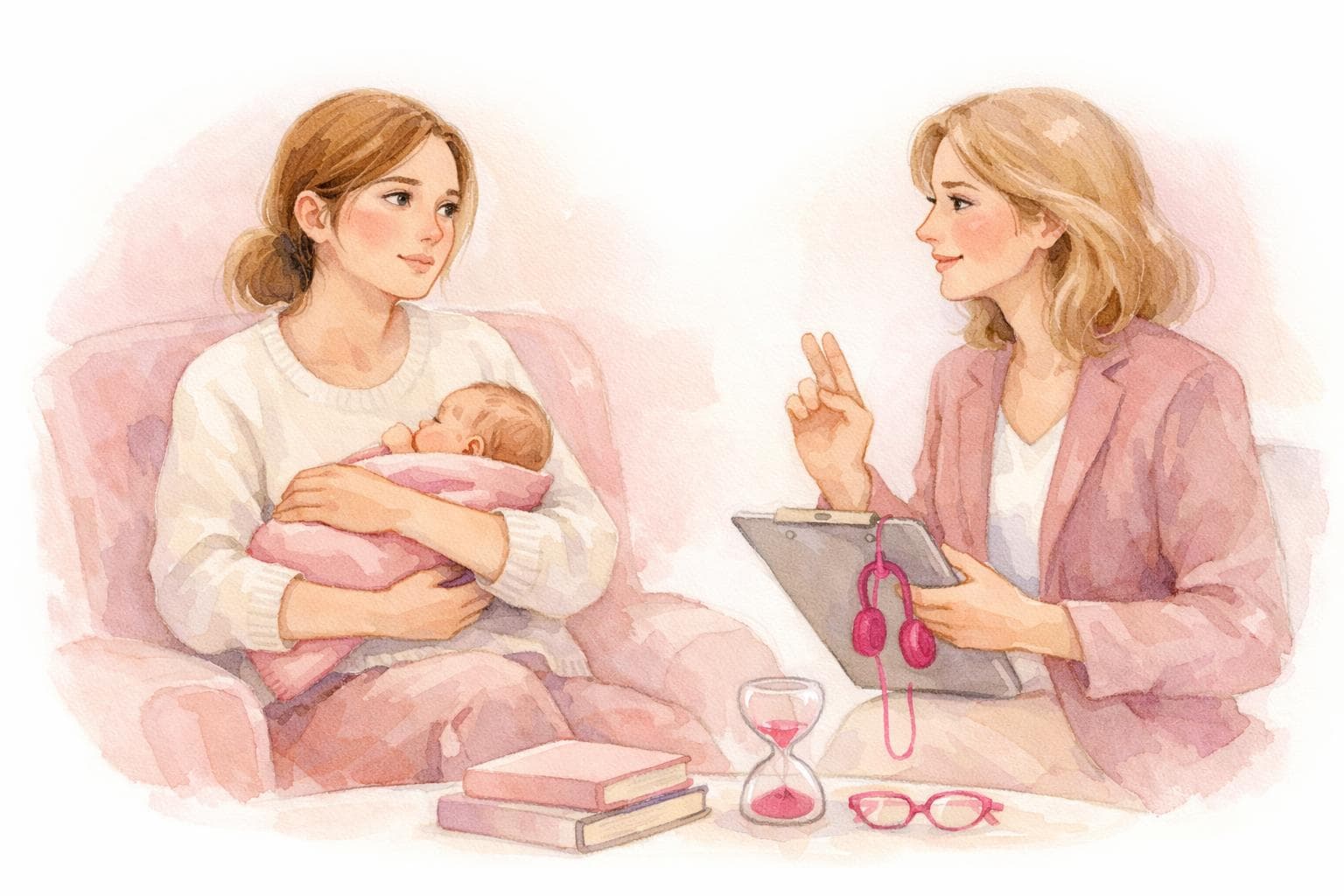
The most important first step is telling someone. A GP, a midwife or a health visitor. You do not need to have a fully formed account of what is happening. Saying "I think I am more anxious than normal and it is affecting my daily life" is enough to begin a conversation that can move toward assessment and support.
Treatment options with good evidence include:
- Cognitive behavioural therapy (CBT), which is specifically effective for anxiety disorders and is recommended by NICE guidelines for perinatal anxiety
- Medication, including SSRIs that are considered safe during breastfeeding, for moderate to severe symptoms
- Supported self-help and psychoeducation, which can be effective for milder presentations
"You don't have to control your thoughts. You just have to stop letting them control you." — Dan Millman
If intrusive thoughts are part of your experience alongside the anxiety, intrusive thoughts in motherhood: you're not a bad mom is a direct companion to this piece. And if you are wondering whether what you're experiencing might be perinatal OCD rather than generalised anxiety, perinatal OCD: what it is and why moms rarely talk about it addresses the distinction clearly.
You are not worrying too much because you are doing motherhood wrong. You are worrying too much because something in your nervous system needs support. Those are very different things.
If you are in crisis or experiencing thoughts of harming yourself or your baby, please contact your GP or midwife immediately. In the UK: Samaritans on 116 123. In the US: 988 Suicide and Crisis Lifeline. Postpartum Support International: postpartum.net.
Further reading: Karen Kleiman & Amy Wenzel, Dropping the baby and other scary thoughts (2011). Jonathan Abramowitz, The stress less workbook (2012). NHS: anxiety disorders in pregnancy and after birth.