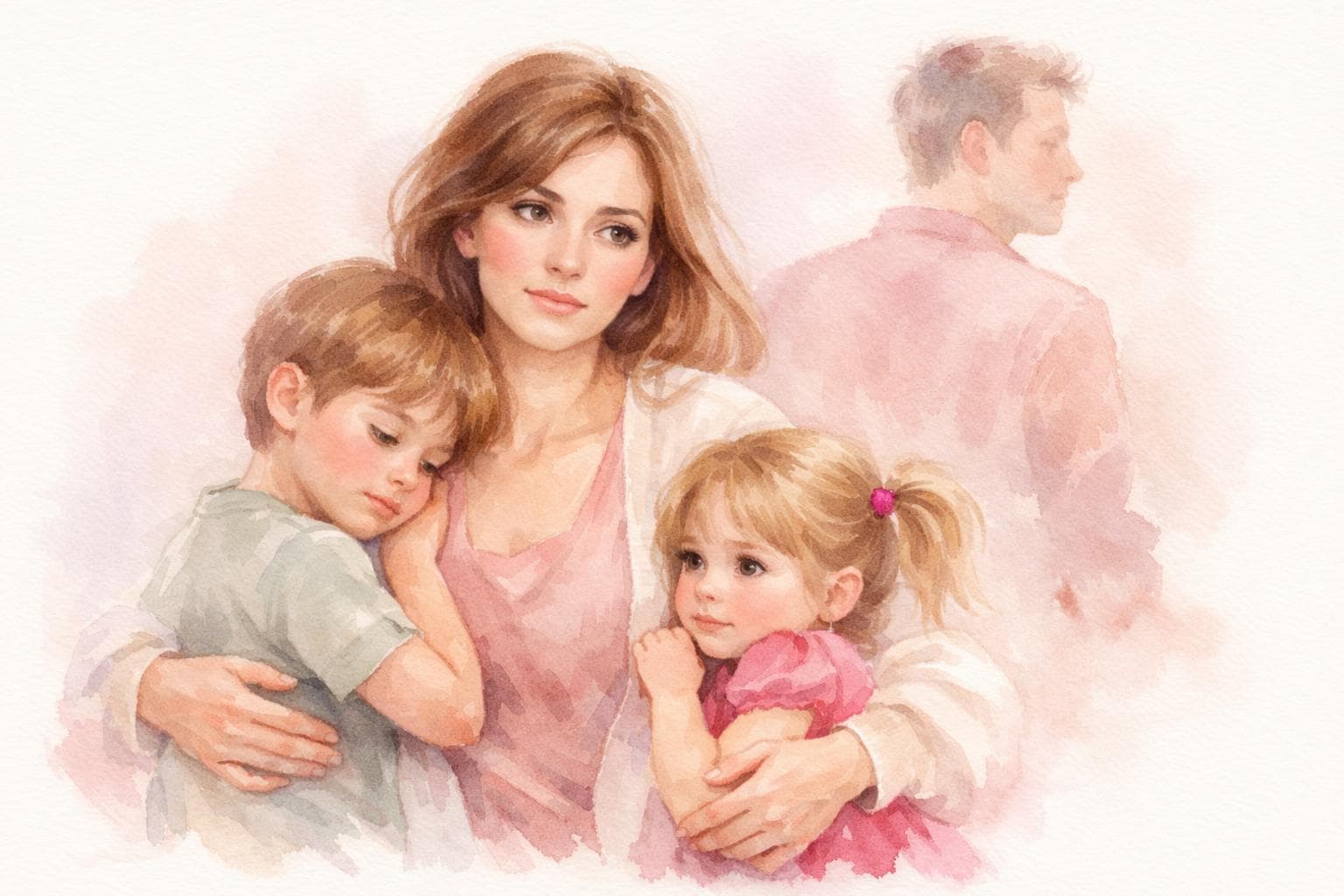
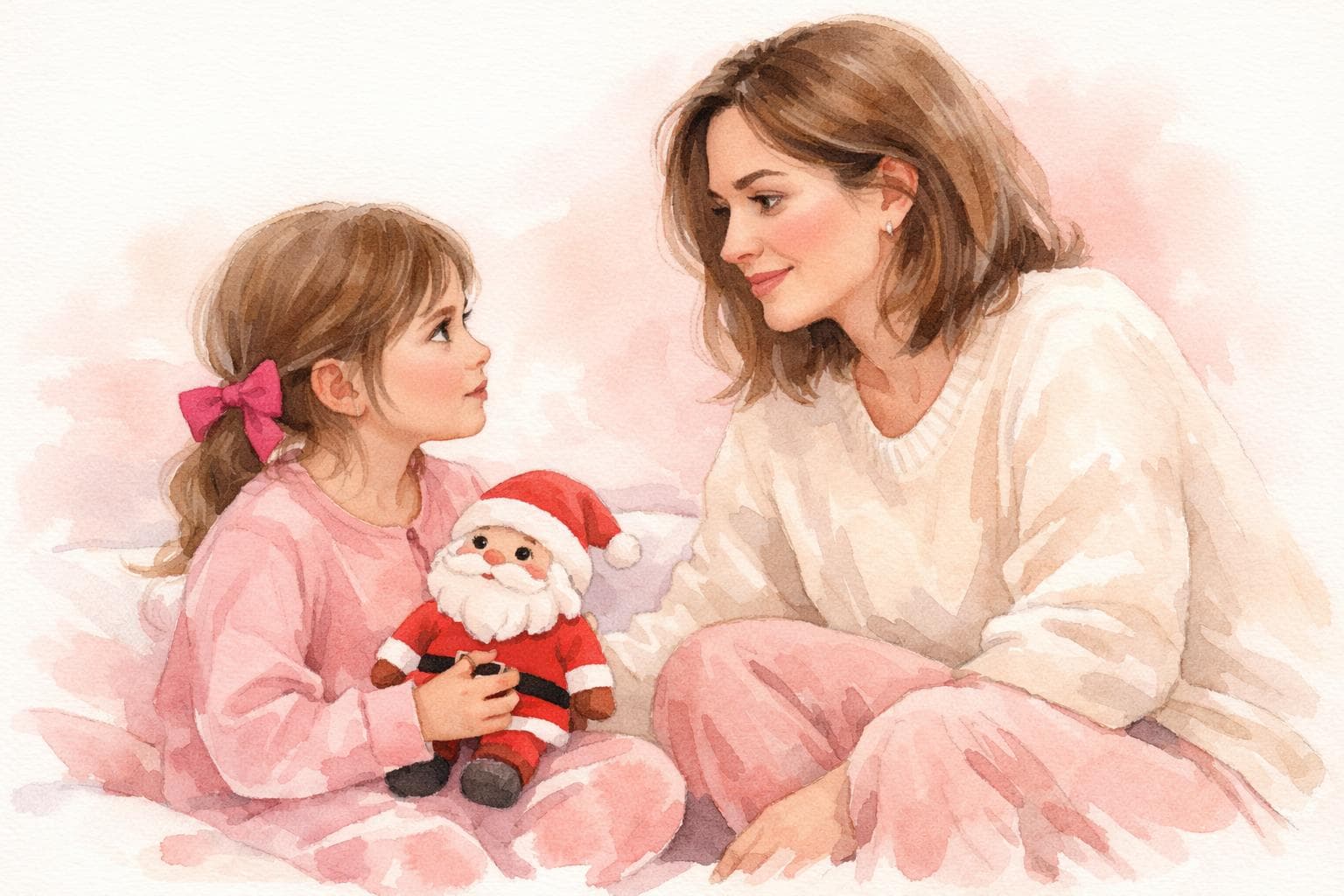
It is bedtime in early December. Your child looks up from the pillow and asks, "Mom, is Santa real?"
Your heart skips. You do not want to ruin the magic. You also do not want to lie to someone who trusts you.
So you stall. "What do you think?" It buys you ten seconds, nothing more.
If this feels like a big moment, it is. Most parents face it. You can handle it with warmth and honesty.
Answering "Is Santa real?" honestly means giving a truthful, age-fit reply that protects your child's trust and still respects the fun of the holiday. There is no single right script. What matters is that your child feels safe asking and gets a calm answer.
How common is Santa belief?
Very common. A 2025 study in Frontiers in Developmental Psychology surveyed 486 US parents of children aged 3 to 8. About 88% said their child believed in Santa. And 85% encouraged the belief. In 1994, only 64% did.
Finding | Number | Source |
|---|---|---|
Parents who say their child believes | 88% | Yoo, Jiang and Rosengren (2025) |
Parents who encourage belief | 85% (up from 64% in 1994) | Yoo, Jiang and Rosengren (2025) |
4-year-olds who believe | 85% | 1978 study, as reported by Science News |
8-year-olds who believe | 25% | 1978 study, as reported by Science News |
Adults who believed as kids | 84% | AP-GfK poll (2011) |
A note on the data. These are mostly US samples and parent reports. The 1978 figures are old and come to us second hand.
A 2002 study in CMAJ interviewed 45 hospitalized children. Cyr found that "belief in Santa is inversely proportional to a child's age." Children under 8 had far higher odds of believing. The sample was small, so treat it as a clue.
When do kids stop believing?
Often around age 7 or 8. Kids start asking how one man fits down every chimney. Jean Piaget linked this age to the "concrete operational" stage, when children think more logically.
Age | What you may see | Helpful move |
|---|---|---|
3 to 5 | Full belief, big wonder | Enjoy it and keep answers simple |
5 to 7 | Questions about how and why | Ask what they think first |
7 to 9 | Doubts and testing | Answer honestly and calmly |
9 and up | Often in on the secret | Invite them to help keep it for others |
This table is a guide from our editorial team. Every child is different.
Three ways to answer, compared
Approach | What you say | Upside | Watch out for |
|---|---|---|---|
Keep the myth | "Santa is real." | Keeps the magic | Direct questions can feel like lying |
Tell the truth early | "Santa is a story." | Fully honest | May spoil play for younger kids |
Playful honesty | "It's a game we play." | Honest and fun | Needs a calm explanation |
Many families choose the third option. It treats Santa as a shared tradition, not a trick. In the 2025 survey, parents who encouraged belief most often called it "part of childhood" (about 78%).
How to answer in the moment
You do not need a speech. Try these steps.
- Stay calm. Your tone tells your child if the topic is safe.
- Ask first. "What makes you wonder?" You learn what they are really asking.
- Match their age. A five-year-old needs less than a nine-year-old.
- Answer the real question. Do not dodge a direct one.
- Keep the warmth. "The giving is real. So is our love."
Here is how a younger and an older child might hear it.
For a younger child: "That's a fun question. Santa is a story about giving. What do you think?"
For an older child: "You've been thinking hard. The gifts come from us. Santa is a tradition about kindness. Want to help keep the fun for others?"
Interview research on children who learned the truth (PubMed 7842832) found they generally did well, while the parents mostly felt sad. That is a reassuring sign.
What if your child feels upset?
Some kids feel sad or tricked. Say, "It makes sense to feel that way. I did it because I love you." Repair matters more than the plot. If guilt creeps in, read how to deal with mom guilt without blaming yourself.
Warmth plus honesty builds trust. Our guide to the 4 parenting styles explains why.
Keep the spirit of the season
Let your child join the giving. Pick a gift for someone in need, bake for a neighbor or write kind notes. For more ideas, see our advent calendar ideas: 60 fillers for kids (no junk) and our fall bucket list.
Key takeaways
- Most US children believe in Santa. The belief usually fades around age 7 or 8
- Ask your child what they think before you answer
- Playful honesty keeps trust and the fun
- Research suggests kids generally cope well with the truth
- Focus on giving, not on the story
Sources and further reading
- Yoo, S. H., Jiang, M. J. & Rosengren, K. S. (2025). "Why Santa but not witches?" Parents' reasoning behind encouraging and discouraging fantasy beliefs in children. Frontiers in Developmental Psychology, 3. frontiersin.org
- Cyr, C. (2002). Do reindeer and children know something that we don't? Pediatric inpatients' belief in Santa Claus. CMAJ, 167(12), 1325 to 1327. pmc.ncbi.nlm.nih.gov
- Science News. The science behind kids' belief in Santa
- Interview study on children's reactions to learning the truth about Santa. PubMed 7842832.
- AP-GfK poll (2011), as reported by Science News.
- Faber, A. & Mazlish, E. (1980). How to Talk So Kids Will Listen & Listen So Kids Will Talk. Avon Books.