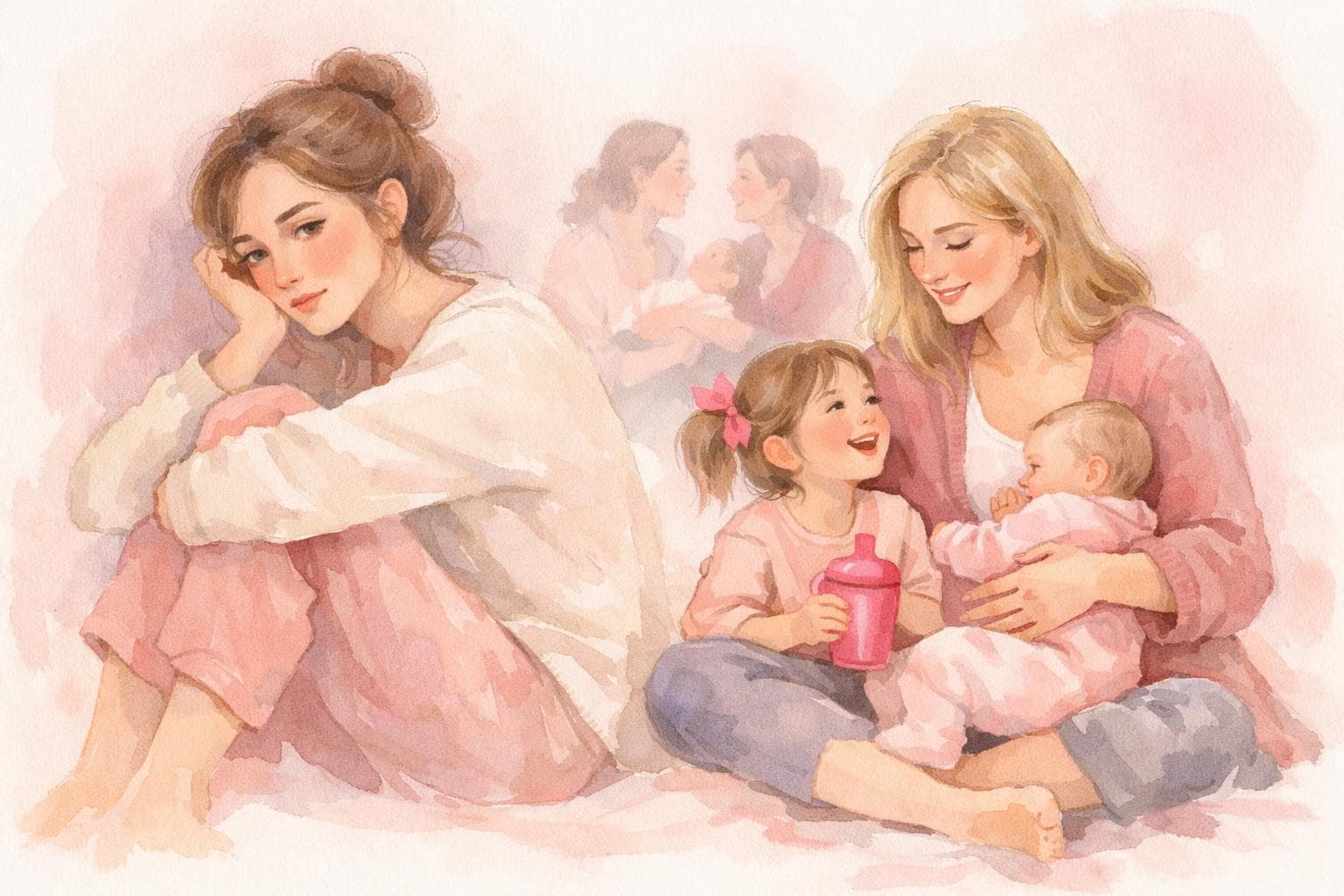

At some point it might be gradual, it might arrive all at once many women realize they have become extraordinarily good at being needed and remarkably unpracticed at simply being themselves.
Not because they stopped caring about who they were. But because motherhood and marriage, each demanding in their own way, have a cumulative effect on personal identity that nobody quite prepared them for. You look up one day and the things that used to feel most essentially yours your interests, your opinions, your private inner life have been crowded to the edges. Still there, technically. But no longer central.
Keeping your identity inside these two roles is not a luxury or an act of selfishness. It is, as the research consistently shows, one of the most important things you can do for your own wellbeing, for your children, and for your relationship. The question is how to actually do it when the structural conditions of modern motherhood push so hard in the opposite direction.
Why Identity Gets Lost in the First Place
The loss of personal identity in motherhood and marriage is not accidental. It follows a logic.
Motherhood, particularly in the early years, requires total attentiveness. Every instinct pulls you toward the child toward their schedule, their safety, their needs. That pull is biological, not just social. Research published in Nature Neuroscience (2016) documented measurable grey matter changes in mothers' brains following pregnancy neurological shifts that specifically heighten attunement to the child's needs and reshape how a mother perceives and prioritizes the world around her.
Marriage adds another layer. Long-term intimate relationships involve their own gradual merging of preferences, habits, social circles, daily rhythms. For many women, this merging is disproportionate: their world contracts toward the family while the reverse is less consistently true for their partners.
Psychologist Harriet Lerner, writing in The Dance of Intimacy (1989), describes this dynamic as "de-selfing" the process by which one person in a relationship gradually sacrifices more and more of their individual self to maintain harmony, closeness, or approval. De-selfing is rarely dramatic. It happens in small concessions that each feel reasonable in isolation. The accumulated effect is the quiet disappearance of a whole person.
Understanding this is important because it reframes the problem. You didn't fail to hold onto yourself. You were operating inside a system that routinely asks women particularly mothers to prioritize everyone else. That's worth naming clearly before expecting yourself to simply do better.
What Identity Looks Like in the Context of These Roles
Before you can protect your identity, it helps to know what you're protecting. Identity, in this context, isn't about having a dramatic sense of individual destiny. It's about something more ordinary and more essential: the specific texture of who you are.
That includes:
- Your values and the way you express them not as a mother, but as a person. What you believe is right, important, worth fighting for.
- Your interests and the things that absorb you genuinely, not as something you're supposed to enjoy.
- Your sense of humor and the particular way you see the world the perspective that makes your friendships and conversations distinctly yours.
- Your professional or creative identity the part of you that exists in relation to work, making, or intellectual engagement rather than caregiving.
- Your relationship with your own body and physical experience movement, rest, sensation, health as yours, not just a vehicle for producing and sustaining others.
- Your inner life the private thoughts, questions, and preoccupations that don't need to be shared with anyone to be valid.
None of these require significant time to maintain. They require attention which is different, and more available than we tend to believe.
The Cost of Losing It (That Goes Beyond You)
Here's what the research is clear on: maternal identity loss is not a private matter. Its effects radiate outward.
A 2020 study in Family Process found that mothers who reported high levels of self-suppression consistently minimizing their own needs and identities had children with elevated anxiety and lower emotional self-regulation than mothers who modeled a more differentiated sense of self. Children, it turns out, learn what personhood looks like from watching the people closest to them. A mother who has no visible identity outside her caregiving role teaches her children something about what women about what people are for.
The relationship dimension is equally significant. Esther Perel has argued across decades of clinical work that distinctness the sense that your partner is a full, separate, somewhat mysterious person is one of the primary engines of sustained desire and connection. When that distinctness collapses, when one partner has become entirely absorbed into the shared unit, the intimacy tends to flatten. Not because love diminishes but because there is less and less of a specific person to be in love with.
When Identity Is PreservedWhen Identity Is Lost
Parenting from a place of fullness, not depletion
Parenting from chronic exhaustion and invisible resentment
Modeling self-worth and personhood for children
Modeling self-erasure as the price of love
Sustaining genuine connection with a partner
Drifting into co-management without real intimacy
Navigating hard seasons from a stable sense of self
Losing ground in every difficult period
Asking for what you need with some directness
Hoping to be noticed and feeling unseen
How to hold onto yourself - practically
The strategies that actually work are less about grand acts of self-reclamation and more about consistent, deliberate small ones.
Protect one thing that is non-negotiably yours. Not conditional on the children being asleep, the house being managed, your partner being available. One thing a practice, a friendship, an interest that exists on your calendar because it matters to you. This is not selfish time. It is structural.
Introduce yourself in ways that include more than your roles. When you describe yourself primarily as someone's mother and someone's wife, those roles become the whole of your self-concept. Practice including more what you're interested in, what you're learning, what you care about beyond your immediate household.
Maintain at least one relationship where you are known as a full person. Not as a parent coordinator, not as a partner. As yourself. A friendship that predates your roles, or one built around your actual self rather than your circumstances, is one of the most protective things you can have. If you've let those friendships go quiet, How to Feel Like Yourself Again After Kids offers a grounded starting point for rebuilding.
Have the conversation about who you are becoming. With yourself, in writing or in thought. With your partner, with some regularity. Couples who stay genuinely curious about each other's evolving inner lives — not just their logistics sustain the quality of connection that the early years tend to erode. How to Balance Being a Mom and a Partner explores how to do this in practice.
Resist the urge to disappear entirely into the "good mother" performance. The pressure to be everything for everyone is real, culturally entrenched, and worth pushing back on deliberately and often. Why Modern Moms Feel More Pressure Than Ever names the structural sources of that pressure which is the first step toward not letting it run the show.
"The most courageous act is still to think for yourself. Aloud." - Coco Chanel
Thinking for yourself, knowing yourself, being yourself alongside the people you love most this is not in conflict with being a devoted mother or a committed partner. It is, in fact, the condition that makes both of those things sustainable over the long run.
You are allowed to remain a person. The roles don't get to take that from you.
Further reading: Harriet Lerner, The Dance of Intimacy (1989). Esther Perel, Mating in Captivity (2006). Kristin Neff, Self-Compassion: The Proven Power of Being Kind to Yourself (2011).