
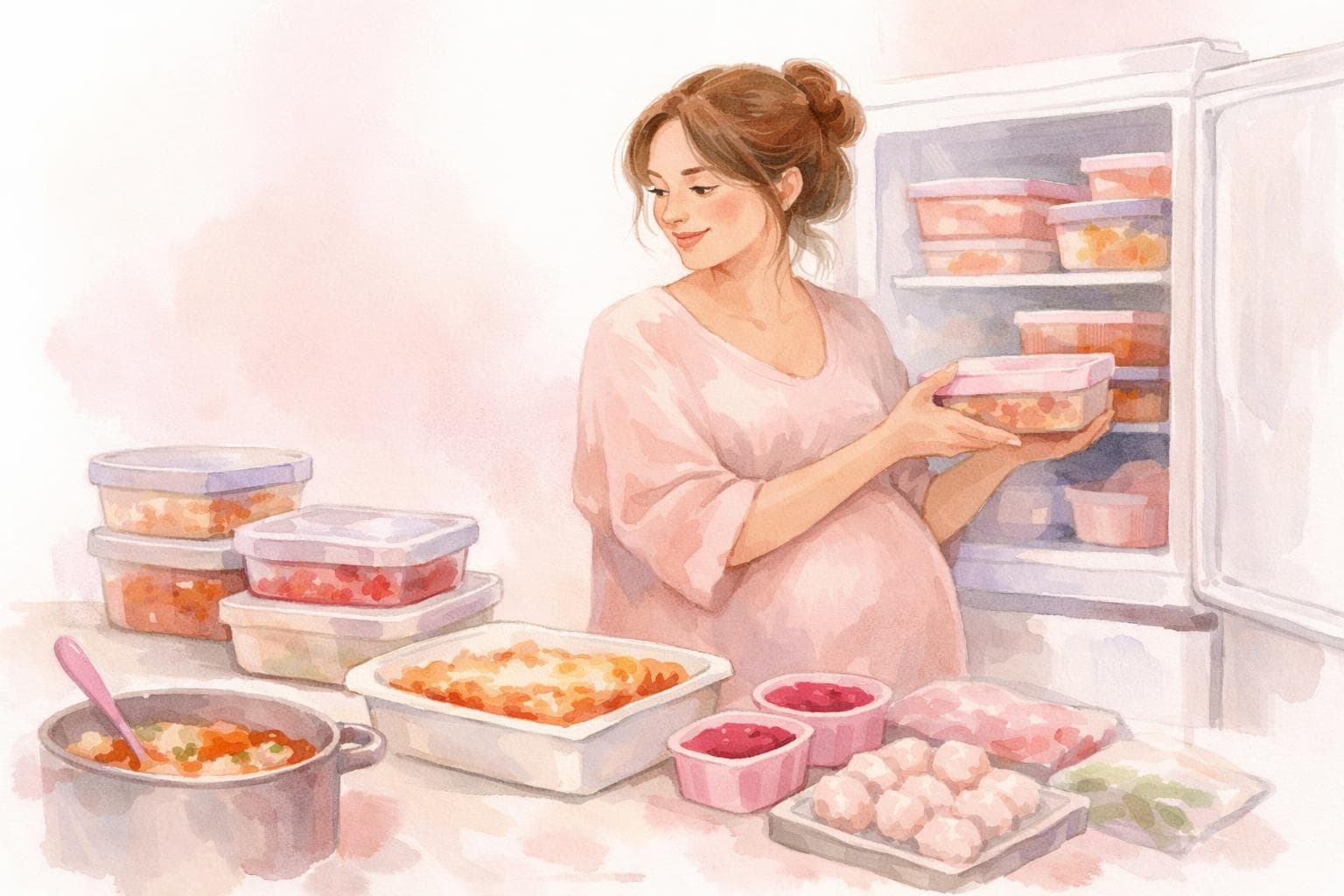
Somewhere around week 32, a strange urge hits. You want to scrub the baseboards, alphabetise the nursery bookshelf and cook. Not casually. With purpose. This is not random. It has a name, and it is trying to tell you something useful: your body knows what is coming, even if your brain is still catching up.
Use that energy on your freezer. It is the single most practical thing a third-trimester nesting instinct can build.
A third-trimester freezer plan is a structured batch-cooking schedule that builds a stocked freezer of ready-to-reheat meals before your due date, timed to your remaining energy and designed to reduce cooking demands during the physically and mentally depleted weeks after birth. Most nutrition guides recommend starting around 28 to 34 weeks, spreading the work across several shorter sessions rather than one exhausting marathon. Breastfeeding mothers need roughly 330 to 400 extra calories daily compared to pre-pregnancy intake, according to the CDC and Mayo Clinic, and one study suggests actual protein needs for exclusively breastfeeding women may be closer to 1.7 to 1.9 grams per kilogram of body weight, higher than older recommendations assumed. A freezer stash built with intention, not an afterthought, is what makes hitting those numbers realistic in the newborn fog.
When to start: comparing the timelines
Different guides recommend different starting points. Here is how they compare, so you can choose based on your own energy and due date.
Start point | Who it suits | Trade-off |
|---|---|---|
Week 20, incremental | Mothers who want to spread effort thin, doubling recipes as they go | Longest runway; lowest weekly effort; requires most freezer space over time |
Week 28, early third trimester | Most mothers; balances energy levels with enough lead time | Most commonly recommended starting point across nutrition guides |
Week 32 to 34 | Mothers who feel most capable mid-third-trimester, before final fatigue sets in | Tighter timeline; still allows 2 to 3 solid batch sessions |
Week 36 or later | Mothers prepping later or adding to an existing stash | Requires shorter, more frequent sessions; less room for error |
After birth | Anyone who did not prep beforehand | Not a failure; small nap-time sessions and delivery services can fill the gap |
If you are reading this with a newborn already here, none of this requires a head start you missed. Small sessions during nap windows still work, and leaning on a meal train from friends can bridge the gap while you build your own stash slowly.
The weekly batch-cook rhythm
Rather than one exhausting cooking marathon, spread the work into short weekly sessions across the third trimester. A single 90-minute session per week, doubling whatever you are already making for dinner, builds a genuinely diverse freezer stash without ever feeling like a project.
Week | Focus | What to batch |
|---|---|---|
1 | Soups and stews | Turkey chili, beef stew, lentil soup |
2 | Slow-cooker proteins | Shredded chicken, pulled pork, beef for tacos or bowls |
3 | Breakfast | Egg muffin cups, baked oatmeal, breakfast burritos |
4 | Casseroles and grain bowls | Sweet potato and turkey bowls, baked pasta, stuffed peppers |
5 | Snacks and extras | Energy balls, muffins, smoothie packs |
6, buffer week | Whatever ran short | Top up categories you are lowest on; freeze in single portions |
18 meals worth the freezer space
Soups and stews: turkey chili, beef and vegetable stew, lentil soup, chicken tortilla soup, minestrone.
Slow-cooker proteins: shredded chicken for tacos, bowls or sandwiches, pulled pork, beef for burrito bowls.
Casseroles and one-pan bakes: baked ziti, stuffed peppers, sweet potato and turkey skillet, shepherd's pie.
Breakfast: egg muffin cups, baked oatmeal, breakfast burritos, banana oat waffles.
Snacks: energy balls, protein muffins.
Each of these freezes and reheats reliably without losing texture, which is not true of every dish. Cream-based sauces like Alfredo tend to separate after freezing, so stick to tomato or broth-based options for anything with a sauce.
Storage and food safety, done right
Food safety matters more here than in ordinary cooking, because your immune system is working overtime during late pregnancy and early postpartum. The FDA recommends the following practices specifically for this window:
- Always separate raw and cooked meats, using different cutting boards
- Cook everything to the proper internal temperature before freezing
- Defrost in the refrigerator, in cold water, or in the microwave, never on the counter at room temperature
- If you thaw something and do not eat it, do not refreeze it
- Use airtight glass or freezer-safe plastic containers, and label everything with the dish name, date and reheating instructions
"Freezer meals refer to dishes prepared in advance and stored at sub-zero temperatures for later consumption. In the context of preparing for a new baby, these meals help reduce daily decision fatigue and physical demands on expectant or new parents." - Freezer Meals Before Baby: What to Prep Guide (2026)
Homemade vs store-bought vs hybrid: which approach fits you
Fully homemade | Store-bought frozen meals | Hybrid approach | |
|---|---|---|---|
Control over ingredients | Full | Limited | Partial |
Time investment | High, spread over weeks | None | Moderate |
Cost | Lower per meal, roughly $2 to $2.50 per serving | Higher, often $8 to $12 per meal | Mixed |
Nutritional consistency | High, if planned well | Variable; often high sodium | Depends on ratio |
Best for | Mothers with time and freezer space in the third trimester | Mothers with limited time or energy to batch cook | Most realistic option for many families |
Most mothers land somewhere in the hybrid column, and that is a perfectly reasonable strategy. A partially stocked freezer plus a few reliable delivery options covers more ground than an all-or-nothing approach to either.
What to prioritise if you are short on time
If the full six-week rhythm is not realistic, prioritise in this order:
- Proteins first. Shredded chicken and ground turkey chili are the most versatile and reheat the most reliably.
- Breakfast second. Mornings with a newborn are the most disorganised part of the day, and grab-and-reheat breakfast options carry outsized value.
- Soups third. Warm, broth-based meals are easy to digest and comforting during recovery.
- Snacks last. Nice to have, but the lowest priority if time runs short.
Our postpartum essentials kit covers the non-food items worth prioritising alongside your freezer stash, and our broader guide to what to bring a new mom is useful if friends and family ask what would actually help.
Key takeaways
- Start batch cooking around 28 to 34 weeks, spread across weekly 90-minute sessions rather than a single exhausting marathon.
- Breastfeeding mothers need roughly 330 to 400 extra calories daily, and some research suggests protein needs are higher than older guidelines assumed, closer to 1.7 to 1.9 grams per kilogram of body weight.
- Prioritise proteins and breakfast items first if time is limited; these carry the most value during the most disorganised hours of a newborn's schedule.
- Food safety matters more during this window. Always separate raw and cooked meats, thaw safely and never refreeze thawed food.
- A hybrid approach, homemade plus a few store-bought or delivered meals, is realistic and sufficient. A perfectly stocked freezer is not the goal; having something nourishing within reach is.
Sources and further reading
- Begin with Balance. (2026). 2026 postpartum meal prep guide: easy and nourishing recipes. beginwithbalance.com
- Clean Eatz Kitchen. (2026). Postpartum meal prep: 6 easy freezer recipes. cleaneatzkitchen.com
- Wellness Alibaba. (2026). Freezer meals before baby: what to prep guide. wellness.alibaba.com
- Bucket List Tummy. (2025). 50+ easy freezer meals for new moms. bucketlisttummy.com
- FDA. (2025). Food safety for pregnant women.
- Ford, N.D. et al. (2020). Micronutrient and physical activity behaviors in lactating women. Cited in Freeze & Thrive postpartum meal prep guide.