The turkey is carved. The gravy is cooling. Your six-year-old is poking a pea with a fork and your teenager is staring at a phone.
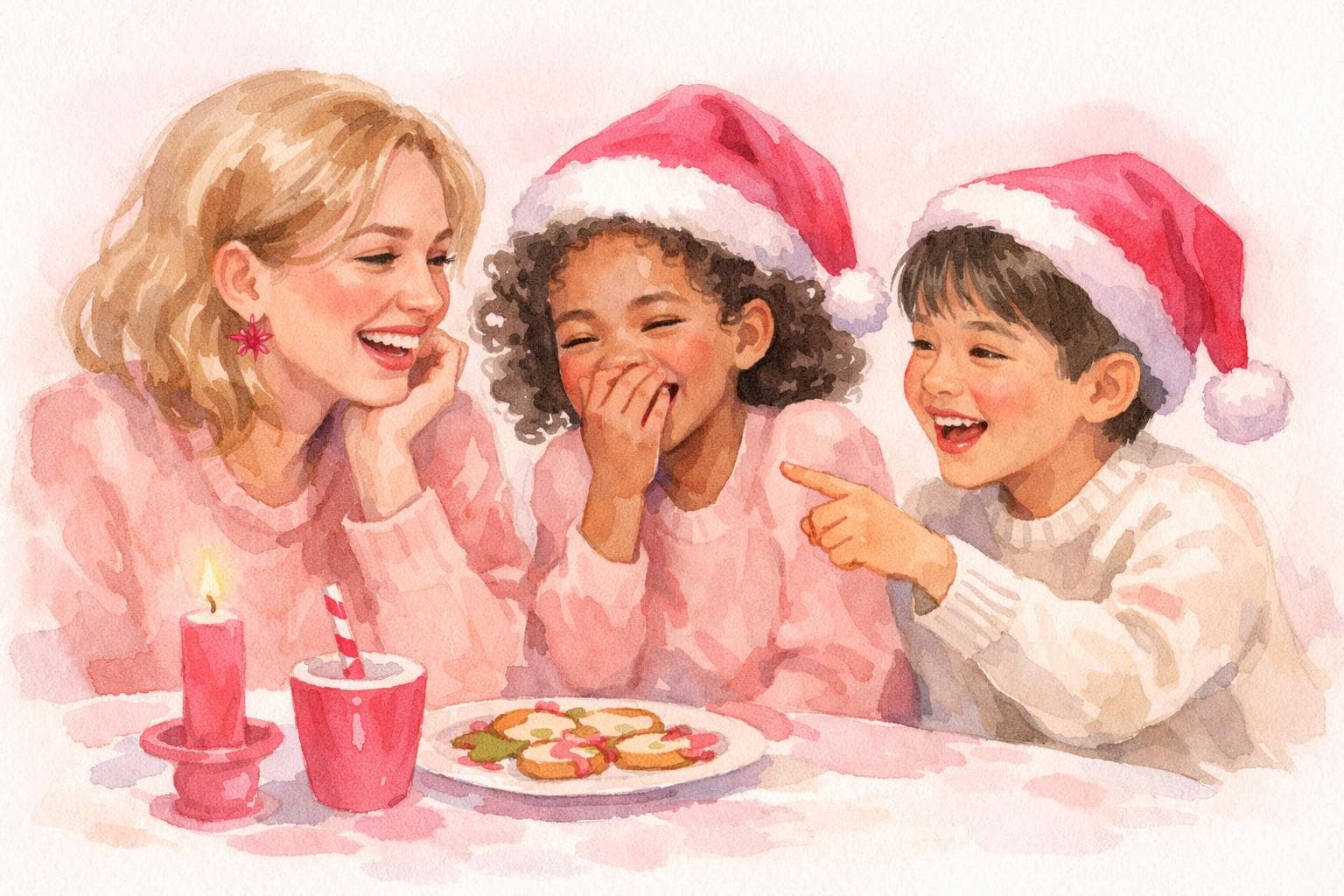
Then someone says a terrible joke. Someone groans. Someone laughs so hard that milk almost comes out of their nose.
That is the moment you wanted. A good joke at the table can change the mood in ten seconds.
Christmas jokes for kids are short, silly riddles and puns about Santa, snow, reindeer, food and gifts that children can read, tell and laugh at together. They need no props and no prep. They work at dinner, in the car and on a long wait for the big day.
Below you will find 120 jokes sorted by theme. You will also find a few tips to make joke time easy.
Why jokes at the table matter
Shared meals and shared rituals are linked to good things for kids. A 2018 meta-analysis in Obesity Reviews by Dallacker, Hertwig and Mata looked at the frequency of family meals and children's nutritional health. A 2002 review in the Journal of Family Psychology by Fiese and colleagues covered 32 publications on family routines and rituals. It linked them to child adjustment and family satisfaction. Both are mostly observational, so treat them as clues and not proof.
Jokes fit into those rituals nicely. They are free and quick. They also let shy kids join in.
Child humor grows with age. Psychologist Paul McGhee describes this in his work on children's humor. Around age 6 or 7 kids start to grasp double meanings in words. This fits the "concrete operational" stage described by Jean Piaget. That is why a pun lands with a seven-year-old and not with a three-year-old.
Table 1. Which jokes fit which age
Age | What they enjoy | Best joke type |
|---|---|---|
3 to 5 | Silly sounds and animal noises | Very short one-liners and knock-knock |
6 to 8 | First real puns and riddles | Q and A riddles |
9 to 12 | Wordplay and groaners | Puns and "dad jokes" |
Teens | Dry or ironic twists | Deadpan one-liners |
This table is a simple editorial guide based on the research above. Every child is different.
120 Christmas jokes by theme
We wrote these ourselves. Many holiday puns are old and common, so a few may sound familiar.
Santa and the elves
- Why does Santa check his list twice? Because he hates being wrong once.
- What does Santa wear to the gym? A ho-ho-hoodie.
- Why did the elf bring a pencil to work? To draw up the toy plans.
- What do elves learn first in school? The elf-abet.
- Why was the elf late? He got stuck in a tinsel jam.
- What is Santa's favorite sandwich? Peanut butter and jolly.
- Why do elves make great bakers? They always rise to the occasion.
- How does Santa send messages? With a jingle text.
- Why did Santa bring a ladder? He heard the gifts were on the next level.
- What is an elf's favorite snack? Elf-served cookies.
- Why did Santa stop at the library? He wanted a good sleigh-read.
- What does Mrs. Claus put on a cold night? Extra cocoa.
- Why is Santa always calm? He knows how to chill.
- Why did the elf go to bed early? He had a big day of toy-making ahead.
- What does Santa say on a hot day? "Ho, ho, hot!"
- Why was the elf a great singer? He always hit the high jingles.
- What do elves use to fix the sleigh? A snow-ber.
- Why did Santa join the band? He already had the bells.
- What is Santa's favorite place to park? A sleigh lot.
- Why did the elf write a letter to himself? He wanted a surprise.
Reindeer
- Why did the reindeer join the choir? He had a great antler range.
- What is a reindeer's favorite game? Hide and sleigh.
- Why was Rudolph good at flashlight tag? His nose never needed batteries.
- What do reindeer wear on their feet? Hoof-ies.
- How do reindeer say hello? "Hey, deer!"
- Why did the reindeer go to school? To get a little deer-gree.
- What does a reindeer eat for breakfast? Hoof-fles with syrup.
- What did one reindeer say to the other in the snow? "You look hoof-ly cold."
- Why are reindeer so polite? They always say "pawsitively."
- What do reindeer say before a race? "May the best deer win."
- Why did the reindeer bring a map? He was feeling a bit lost in the clouds.
- What is a reindeer's favorite sport? Snow-ccer.
- Why was the reindeer so tired? He had a long night of sleigh-ing it.
- What is Rudolph's favorite song? Anything with a good red beat.
- Why did the reindeer fall asleep at dinner? He was full of oats.
Snow and winter
- What do you call a snowman with a six-pack? An abdominal snowman.
- Why was the snowman sad? He had a meltdown.
- What do snowmen eat for breakfast? Frosted flakes.
- How do snowmen get around? By icicle.
- What do you call a snowman in July? A puddle with a carrot.
- Why did the snowman call his dog Frost? Because Frost bites.
- Where do snowmen keep their money? In a snow bank.
- What is a snowman's favorite place to dance? A snow ball.
- Why did the scarf win a prize? It was a real neck-and-neck.
- What do you call a penguin in the desert? Lost.
- What do snowflakes wear on their heads? Snow caps.
- Why did the snowman bring a broom? He wanted to sweep the competition.
- What is cold, white and goes up? A snowball in the wrong direction.
- Why do mittens never get lost? They stay in a pair.
- What did one snowflake say to another? "We are all unique."
Food and the holiday table
- Why did the cookie go to the doctor? He felt crummy.
- What is a turkey's favorite dessert? Peach gobbler.
- Why did the gingerbread man run so fast? He wanted to beat the milk.
- What do you call a nervous potato? A shaky mash.
- Why was the pie so good at math? It knew its pi.
- What does cocoa say after a long day? "I'm marshmallow-ed out."
- Why did the candy cane go to school? It wanted to be well rounded.
- What do you call a sleepy cookie? Tired and crumbly.
- Why did the bread feel proud? It was on a roll.
- Why did the peas get invited to dinner? They were great at rolling with it.
- Why was the cranberry so happy? It was in a good jam.
- What did the plate say to the fork? "Dinner is on me."
- What kind of music do carrots like? Root and roll.
- Why did the napkin win the contest? It was a real wipe-out.
- What do you call a snack for a snowman? A snow cone.
- Why did the cake smile? It was the icing on the day.
- What is a ghost's favorite pudding? Boo-berry.
- Why did the spoon bring a friend to dinner? It did not want to be stirred alone.
- What does a stuffed turkey say? "Fill me in later."
- Why is cocoa so friendly? It always warms up to you.
Gifts, wrapping paper and the tree
- Why did the tree go to the barber? It needed a trim.
- What do you call a gift that talks? A present with a message.
- Why was the ribbon so good at parties? It really knew how to tie one on.
- What did the box say to the bow? "You complete me."
- Why did the ornament feel proud? It was hung up on success.
- What does a tree wear in winter? Pine-jamas.
- Why was the star on top so calm? It was above it all.
- What do lights say at midnight? "We are on a roll."
- Why did the wrapping paper giggle? It was a bit tear-able.
- What is a tree's favorite subject? Needle-point.
- What did the gift say to the tag? "Please read me."
- Why was the stocking so happy? It was always filled with joy.
- Why did the tinsel hide? It was feeling a little shy and shiny.
- What did the candle say to the cake? "You light up my life."
- Why was the doorbell so cheerful? It loved a good ring-a-ding.
Knock-knock jokes
- Knock knock. Who's there? Snow. Snow who? Snow use knocking. Nobody is home.
- Knock knock. Who's there? Wrap. Wrap who? Wrap up warm. It is cold outside.
- Knock knock. Who's there? Mary. Mary who? Mary Christmas to you.
- Knock knock. Who's there? Olive. Olive who? Olive the presents under the tree.
- Knock knock. Who's there? Cocoa. Cocoa who? Cocoa-ming in. It is chilly.
- Knock knock. Who's there? Ivan. Ivan who? Ivan to open my present now.
- Knock knock. Who's there? Dishes. Dishes who? Dishes the best gift ever.
- Knock knock. Who's there? Jingle. Jingle who? Jingle all the way, open the door.
- Knock knock. Who's there? Tinsel. Tinsel who? Tinsel I see you in the morning.
- Knock knock. Who's there? Elf. Elf who? Elf me find my socks.
- Knock knock. Who's there? Sleigh. Sleigh who? Sleigh it with a smile.
- Knock knock. Who's there? Ice. Ice who? Ice a cookie on the plate.
- Knock knock. Who's there? Frost. Frost who? Frost one in line gets cake.
- Knock knock. Who's there? Noel. Noel who? Noel, it is me again.
- Knock knock. Who's there? Holly. Holly who? Holly days are here.
Silly one-liners and sound jokes for little ones
- What does a cow say at Christmas? Moo-ry Christmas.
- What does a dog sing in winter? Jingle yelps.
- What does a cat say at the tree? "Mew-sic, please."
- What do ducks give each other at Christmas? Quack-ers.
- What does a sheep say in the snow? "Baa-rrr, it is cold."
- What does a frog sing at Christmas? "Jingle bells, ribbit, ribbit."
- What do you call a bell that is sleepy? A snooze-ring.
- What does a bear wear in December? A fur-ever coat.
- What does a mouse bring to the party? Cheese and crackers.
- What does the snowman say to the carrot? "Nice nose."
- What does a bird tweet on Christmas Eve? "Chirp-mas!"
- What does a pig want for Christmas? A little snout-fit.
- What does a horse say at dinner? "Hay, pass the carrots."
- What does a clock say on Christmas? "It is time for gifts."
- What does a bee wear in winter? A buzz coat.
- What do monkeys sing at Christmas? "Jungle bells."
- What does a chicken say at the tree? "Cluck-ing good."
- What does a puppy say about snow? "Pawsome!"
- What does a goat ask Santa for? A grass-y gift.
- What does a kid say after the last joke? "Tell it again!"
Check your own family's taste. A joke that makes one child howl can fall flat for another.
Joke types compared
Table 2. Pick the right joke for the moment
Type | Best for | Length | Why it works | Watch out for |
|---|---|---|---|---|
Knock-knock | Ages 3 to 7 | Short | Kids join in and say the lines | Can get repetitive |
Q and A riddle | Ages 6 to 10 | Short | Builds word skills | Needs a pause before the answer |
Pun | Ages 8 and up | Short | Fun for mixed ages | Groans are part of the fun |
Story joke | Ages 9 and up | Longer | Keeps the table focused | Easy to lose small kids |
Sound joke | Ages 3 to 5 | Very short | Silly and easy | Fades fast with older kids |
How to make joke time easy
You do not need a script. Try these small ideas:
- Write 10 jokes on slips and put them in a bowl
- Let each person draw one at dessert
- Give a "best groan" prize
- Ask the youngest to read first
- Skip any joke that could embarrass a guest
If you are planning a full December, see our advent calendar ideas: 60 fillers for kids (no junk). You may also like the fall bucket list for kids and the Thanksgiving activities for kids. Table tension is real, so read how to deal with mom guilt if hosting feels heavy.
Key takeaways
- Short, silly jokes can lift the mood at any holiday table in seconds
- Pick the joke type by age: sound jokes for little ones and puns for older kids
- Shared meals and rituals are linked to good outcomes for kids, though most research is observational
- Keep it easy. A bowl of jokes and a "best groan" prize are enough
- The best joke is the one your family laughs at together
Sources and further reading
- Dallacker, M., Hertwig, R. & Mata, J. (2018). The frequency of family meals and nutritional health in children: a meta-analysis. Obesity Reviews. DOI 10.1111/obr.12659
- Fiese, B. H. et al. (2002). A review of 50 years of research on naturally occurring family routines and rituals: cause for celebration? Journal of Family Psychology, 16(4). pubmed.ncbi.nlm.nih.gov
- McGhee, P. E. Understanding and Promoting the Development of Children's Humor. laughterremedy.com
- Piaget, J. Work on the concrete operational stage of child development.
- Feiler, B. (2013). The Secrets of Happy Families. William Morrow.