When your relationship struggles after kids
There's a version of early parenthood that looks, from the outside, like it should be the happiest period of a couple's life. New baby. New chapter. Love made visible in a tiny, squirming, completely helpless form.
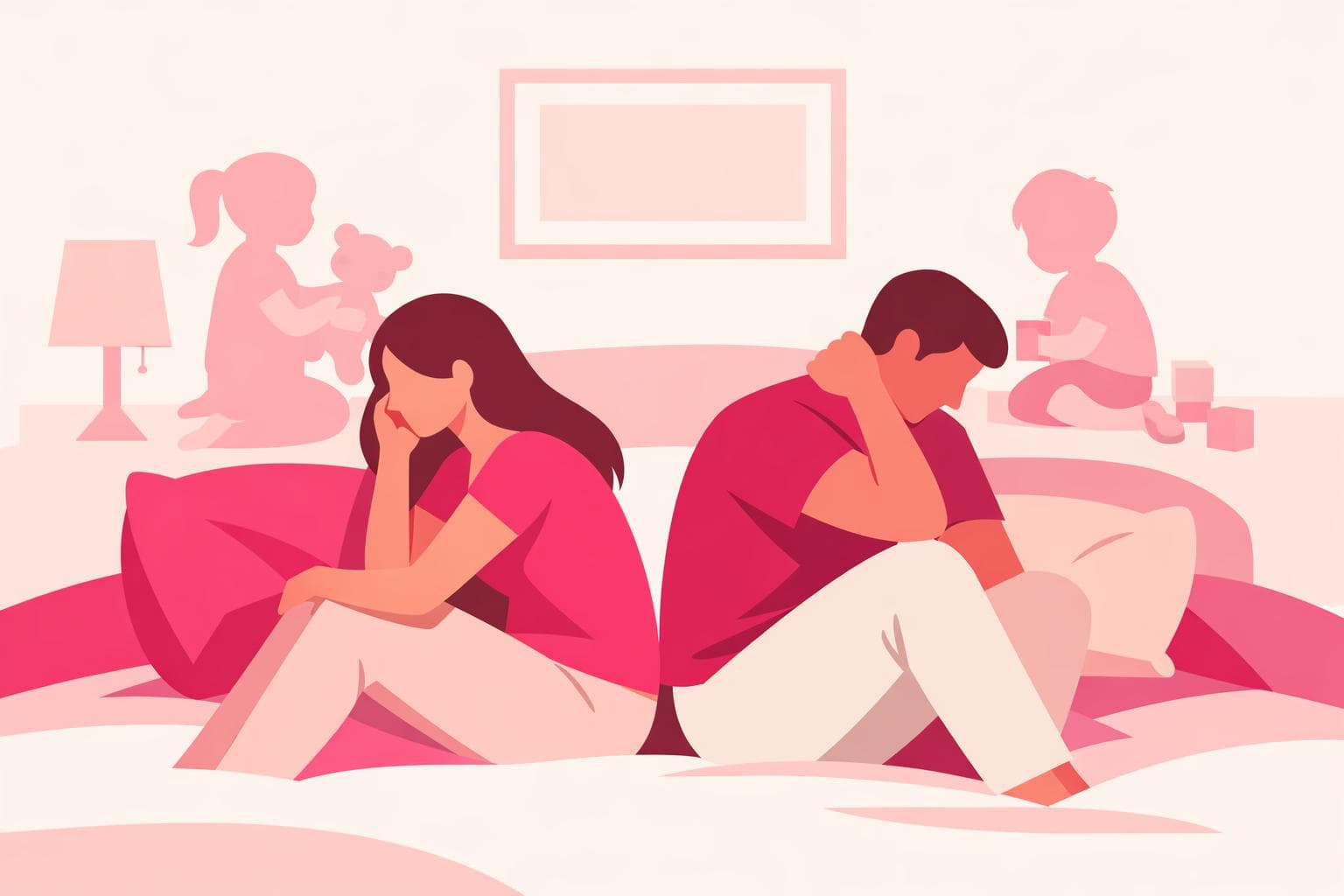
And then there's what it often feels like from the inside: like two people who used to know each other well are now strangers who happen to share a house, a child, and an ongoing negotiation about whose exhaustion takes priority tonight.
If your relationship has felt harder since having children more distant, more tense, more transactional you are not failing at love. You are experiencing one of the most well-documented transitions in relationship science. And the fact that it's common doesn't make it less painful. But it does mean there is a map.
The research nobody tells you about before you have kids
The data on relationship quality after the arrival of a first child is, to put it plainly, sobering.
Relationship researchers John Gottman and Julie Schwartz Gottman, who have spent decades studying what makes couples succeed or fail, found in their longitudinal research that 67% of couples experienced a significant decline in relationship satisfaction within three years of having their first child. The drop was sharpest in the first year. The couples who fared worst were not the ones who had the most conflict — they were the ones who had stopped being emotionally present to each other entirely.
A 2021 study published in Personal Relationships found that the primary mechanisms behind this decline were role overload particularly in mothers combined with a collapse in positive daily interactions between partners. The ordinary moments of warmth, humor, and mutual acknowledgment that sustain relationships got crowded out by the logistics of keeping a small person alive.
What this research tells us, importantly, is that relationship struggle after kids is not a sign of incompatibility. It is a structural problem a collision between the enormous demands of new parenthood and the insufficient resources most couples have to manage them.
What "struggling" usually looks like
Relationship difficulty after children rarely arrives as a single dramatic rupture. It accumulates. And it tends to show up in patterns that are recognizable once you know what you're looking for:
- Conversations that never go beneath the surface. Every exchange is about logistics who's picking up, what's for dinner, whose turn it is. The texture of actual connection disappears.
- Irritability that has no obvious cause. Small things trigger disproportionate reactions because the larger, unaddressed tensions have nowhere else to go.
- Feeling like co-managers rather than partners. You run the household together with increasing efficiency and decreasing intimacy.
- Parallel exhaustion with no acknowledgment. Both partners are depleted. Neither feels seen in their depletion by the other.
- Physical and emotional distance that starts to feel normal. Weeks pass without a real conversation. The distance becomes the default rather than the exception.
- Resentment that's hard to name. Not directed at a specific event — at the accumulation of unmet needs, unseen effort, and unexpressed disappointment.
If you recognize that last one in particular, Resentment in Motherhood: Where It Comes From maps its origins with more granularity than there's space for here.
Why this happens: the real reasons
Understanding the mechanisms behind relationship struggle doesn't fix anything on its own. But it does change the story from "we've fallen out of love" to "we are under enormous pressure and haven't found a way through it yet." That reframe matters more than it sounds.
What Couples Often Think Is the ProblemWhat Research Suggests Is Actually Happening
"We've grown apart"
Physical and emotional proximity has collapsed under the weight of new demands
"We want different things"
Unspoken needs and expectations are creating distance neither partner can name
"The spark is gone"
Positive interactions have been squeezed out by logistics and exhaustion
"We don't communicate anymore"
Communication has narrowed to task management, abandoning emotional connection
"We've become incompatible"
Unresolved conflict and unacknowledged labor are generating resentment
"I don't know this person anymore"
Both partners have changed significantly — and neither has kept pace with the other's evolution
The last one is worth dwelling on. Parenthood changes people. It shifts values, priorities, capacities, and self-understanding in ways that are profound and often unexpected. The person you are at 35 with a toddler is genuinely different from the person you were at 30 without one. Relationship struggle after kids is sometimes, at its root, a question of whether two people who have each changed significantly have stayed curious enough about each other to keep up with those changes.
What actually helps beyond "Date Nights"
The advice that circulates most often about maintaining a relationship after children schedule date nights, hire a babysitter, don't let the romance die is not wrong, exactly. It's just operating at the surface of a problem that runs considerably deeper.
What relationship research and clinical work consistently points to:
1. Name what's happening before trying to fix it. The first conversation that needs to happen is often not about solutions. It's about recognition both partners acknowledging that something has shifted, that the distance is real, that it matters to both of them. Gottman's research found that couples who could describe their relationship problems together, without blame, were significantly more likely to repair successfully than those who couldn't.
2. Rebuild friendship before attempting romance. Gottman's concept of the "Sound Relationship House" puts friendship deep, genuine knowledge of and interest in each other as individuals as the foundation on which everything else rests. Romance and physical intimacy often return naturally when the friendship beneath them is tended. The reverse is rarely true.
3. Address the labor imbalance explicitly. Relationship tension after children is frequently entangled with an unequal distribution of invisible domestic and emotional labor. That imbalance will not resolve itself through goodwill alone. It requires a direct, practical conversation one that Eve Rodsky's framework in Fair Play (2019) provides concrete tools for navigating.
4. Seek support before crisis point. Couples therapy is most effective when accessed early before patterns have calcified and before contempt has moved in. If you're struggling now, that's exactly the right time to reach out. How Therapy Can Help Moms Who Feel Stuck makes the case for professional support without making it feel like admission of failure.
5. Tend to yourself as well as the relationship. You cannot contribute something you don't have. The work of staying connected to yourself your needs, your identity, your wellbeing — is not in competition with the work of maintaining your relationship. It is its prerequisite. How to Balance Being a Mom and a Partner explores this dual responsibility more fully.
On the meaning of a hard season
"Every couple has a love story. The question is whether they're willing to keep writing it especially through the chapters that aren't easy." - Sue Johnson, Hold Me Tight (2008)
A relationship that struggles after children is not necessarily a relationship that is ending. It is often a relationship that is being asked to become something more honest, more resilient, and more deliberately built than it was before.
The couples who come through this period intact not unchanged, but intact are rarely the ones who escaped the difficulty. They are the ones who faced it together, imperfectly, with enough honesty and enough remaining goodwill to keep choosing each other while they figured out how.
That is not a small thing. And it is entirely possible.
Further reading: John M. Gottman & Julie Schwartz Gottman, And Baby Makes Three (2007). Sue Johnson, Hold Me Tight: Seven Conversations for a Lifetime of Love (2008). Eve Rodsky, Fair Play (2019).
Frequently Asked Questions
- Why does my relationship feel worse after having a baby?
- Many couples experience a drop in relationship satisfaction after the first child because sleep loss, role overload, and nonstop logistics leave less room for connection. This is common and does not mean the relationship is broken or that you chose the wrong partner.
- Is it normal to feel distant from my partner after kids?
- Yes, feeling more distant, tense, or like roommates is a very common early-parenthood experience. The shift usually comes from exhaustion and reduced emotional bandwidth, not a lack of love.
- What are the biggest reasons couples struggle after having children?
- The main drivers are mental and physical overload, unequal labor, and the loss of small positive interactions like humor, affection, and easy conversation. When every interaction becomes about scheduling or problem-solving, connection can start to fade.
- Does having conflict mean our relationship is failing?
- Not necessarily. Research suggests the bigger concern is when couples stop being emotionally present with each other, not when they occasionally argue. Conflict is often easier to repair than ongoing disconnection.
- How can couples start improving their relationship after kids?
- Start by reducing pressure and rebuilding small moments of warmth, appreciation, and teamwork. Even brief check-ins, shared humor, and clearer division of responsibilities can help restore connection over time.

a freelance writer and certified maternal wellness coach with a background in psychology and over two years of experience writing about motherhood, mental health, and relationships.