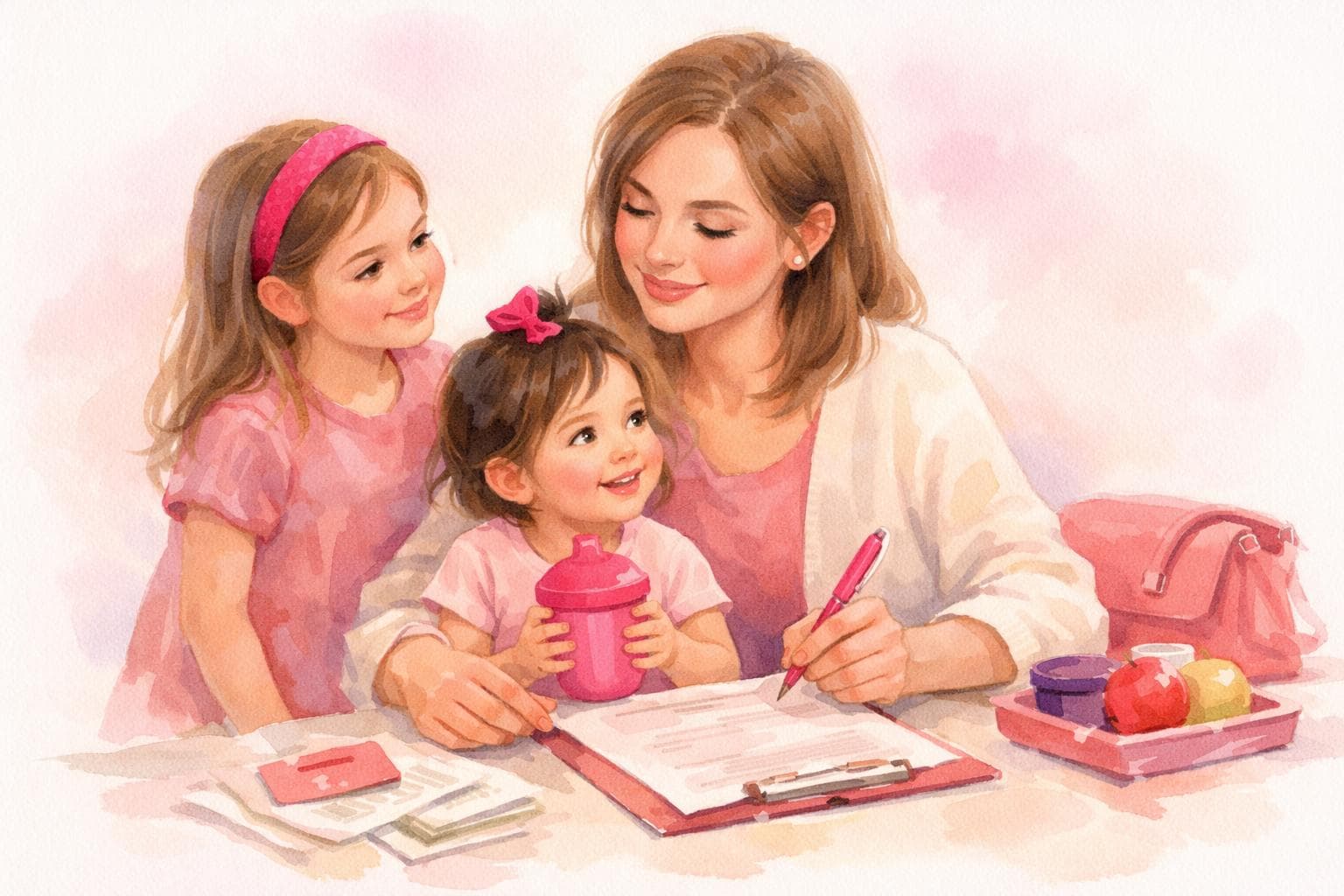

Nobody tells you about the Sunday night feeling.
Not the practical stuff the CV gaps, the interview nerves, the software you haven't used in three years. Those things are real, but they're solvable. What's harder to prepare for is the feeling that arrives the night before you start or the night before the interview or even the night you first sit down to update your LinkedIn profile and realize you don't quite know how to describe what you've been doing.
Returning to work after years at home with children is one of the most emotionally complex professional transitions a person can make. It involves not just re-entering a workplace, but re-entering a version of yourself that you haven't inhabited for a while and discovering, in the process, that she's both more and less familiar than you expected.
What makes this transition different
Career gaps are common. What makes a maternal career gap distinct is the identity dimension.
When you step back from work to care for children, you don't simply pause your professional life. The care work fills the space completely and over time, the professional self that existed before starts to feel like a memory of a different person. Her confidence, her competence, her comfortable knowledge of what she was doing and why she was good at it. All of that gets quietly stored somewhere while other things take precedence.
Coming back means retrieving it. Which turns out to be more complicated than most people expect.
A 2020 report from the Harvard Business Review found that 43% of women with children leave the workforce at some point, and that the majority who want to return face significant barriers not only structural ones like flexibility and childcare costs, but psychological ones: imposter syndrome, loss of professional confidence, and difficulty articulating the value of the years spent at home. The gap on the CV that was a parenting decision gets filtered through a professional culture that still, in many industries, reads it as a question mark.
The feelings that come up (often all at once)
Returning to a career after years at home is rarely one thing emotionally. It tends to be several contradictory things happening simultaneously which is part of why it's so disorienting.
There's excitement genuine, real excitement about using a different part of your brain about being in a professional context again, about the person you remember being when work was going well.
There's grief for the chapter that's closing. Even when returning to work is entirely the right decision and even when you're relieved about it, there's often a mourning of the full-time caregiving period that doesn't get much airtime because it complicates the narrative.
There's guilt, arriving reliably, regardless of circumstances. Not because you're doing something wrong but because the cultural script about what good mothers do is deeply internalized and doesn't update easily.
And underneath all of it for many women, there's something that's hard to name but feels like this: What if I'm not the same? What if I go back and I'm not as good as I used to be?
That fear is worth taking seriously not because it's accurate but because it drives a lot of the behavior that makes the transition harder than it needs to be.
What the research actually says about returning mothers
The data is more encouraging than the internal narrative tends to be.
McKinsey's 2022 Women in the Workplace report found that women returning from career breaks consistently underestimate their own skills and overestimate how much the professional landscape has changed in their absence. In interviews, returning mothers routinely cited skills developed during caregiving crisis management, negotiation, emotional intelligence, project coordination that directly translated to professional value but that they hadn't thought to count.
Psychologist Carol Dweck's research on growth mindset is relevant here in a specific way: the belief that abilities are fixed rather than developable is what makes a career gap feel like permanent deterioration rather than temporary rustiness. Most professional skills, even technical ones, return faster than people expect. The confidence usually takes longer than the competence which means most returning mothers are more capable than they feel.
What returning mothers fear what research tends to find
Skills have become permanently outdated
Most skills return quickly, technical ones can be refreshed
They've lost their professional confidence
Confidence rebuilds with each small professional success
Employers will see the gap as a red flag
Many employers value returning parents' reliability and maturity
They've missed too much to catch up
The pace of change varies enormously by field
They're starting over from zero
Most returning mothers re-enter at or near their previous level
The guilt that nobody prepared you for
Of all the feelings, guilt tends to be the most persistent and the most irrational.
Guilt about leaving the children in childcare even when the childcare is excellent. Guilt about being relieved to leave for work in the morning. Guilt about enjoying the commute. Guilt about the meeting that ran late and the pickup that happened last. Guilt, essentially, about having a self that extends beyond the role of mother.
What helps is not resolving the guilt but recognizing it for what it is: a learned response to a cultural message, not an accurate moral signal. Your children are not harmed by you having a career. Research from Harvard Business School found that daughters of employed mothers are more likely to have careers themselves, earn higher salaries, and hold supervisory positions and sons of employed mothers are more likely to contribute equally to household labor as adults. The model you provide matters. And it matters in the direction of your going back not staying home.
If the guilt has become an obstacle not just a background noise but something that's actively getting in the way How to Prioritize Yourself Without Guilt addresses the internal architecture of that pattern with more specificity than there's space for here.
On not being the same person who left
You probably won't be. That's not a problem.
The version of you returning to work has navigated things the previous version hadn't. She's managed complexity, ambiguity, and sustained pressure in conditions that a conventional professional environment rarely replicates. She has a different relationship to what matters and what doesn't — which tends to make her a clearer thinker and, often, a better colleague.
"You are not the same person who walked into that building three years ago. Good. That person hadn't been through this yet." unknown but it's the thing someone should have said to you before you started.
The professional self you're returning to isn't the one you left. It's a more developed version of her, returning to a context that she's going to approach differently than she did before. That's not a disadvantage. It's usually an advantage, even when it doesn't feel like one yet.
For the broader identity questions that surface during this kind of transition the ones that go beyond the CV and the job title — What Motherhood Taught Me About Myself is worth reading as a companion piece. And if the identity shift of returning feels destabilizing rather than just uncomfortable, How to Feel Like Yourself Again After Kids starts a little further back and works through it from the beginning.
The Sunday night feeling, by the way, does pass. Not immediately. But it does.
Further reading: Carol Dweck, Mindset: The New Psychology of Success (2006). Herminia Ibarra, Working Identity: Unconventional Strategies for Reinventing Your Career (2003). Tara Mohr, Playing Big: Practical Wisdom for Women Who Want to Speak Up, Create, and Lead (2014).